Construction sites are dynamic, challenging environments where safety, efficiency, and cleanliness are paramount. From fine silica dust to heavy concrete debris and unexpected liquid spills, these job sites present unique cleaning hurdles that standard vacuums simply cannot overcome. Investing in the right industrial vacuum cleaner is not merely about tidying up; it’s a critical strategy for protecting workers, ensuring regulatory compliance, and boosting overall project productivity. This comprehensive guide will equip you with the knowledge to select the perfect industrial vacuum that stands up to the rigors of any construction project, safeguarding your investment and your team.
Overview of Industrial Vacuum Cleaners
Vacuum cleaners, in their simplest form, are devices designed to suck up dirt and debris using an air pump. While household models suffice for general cleaning, the demands of a construction site require a far more robust and specialized machine. Industrial vacuum cleaners are engineered for continuous, heavy-duty operation in harsh environments, built to handle materials that would quickly destroy lighter-duty equipment.
The history of vacuum cleaners dates back to the late 19th century, evolving from manual sweepers to powered devices. Over time, as industrial processes became more complex and health regulations stricter, specialized industrial vacuums emerged. These powerful machines are now indispensable tools on construction sites, designed to tackle everything from microscopic dust particles to large, abrasive waste materials.
Modern industrial vacuums for construction vary significantly, but they generally fall into categories based on their capabilities, such as wet/dry functionality, dust extraction, and advanced filtration. Unlike their domestic counterparts, they feature heavy-duty construction, powerful motors, large capacities, and sophisticated filtration systems to meet the unique challenges of building sites.
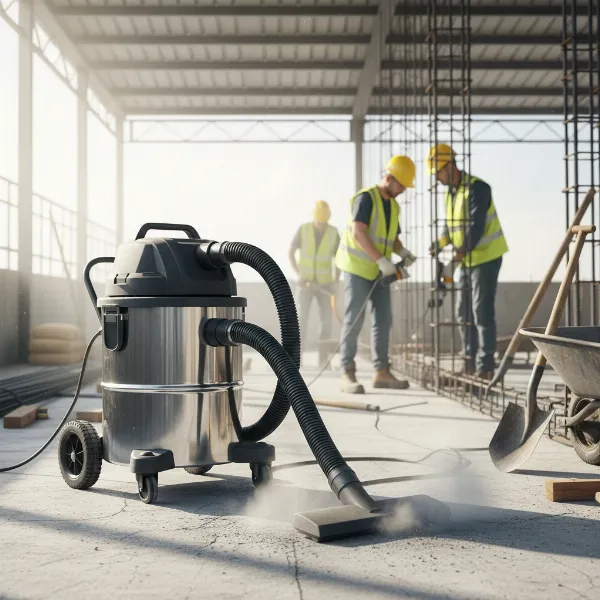 Industrial vacuum cleaner operating on a busy construction site, managing dust and debris effectively.
Common Types of Industrial Vacuum Cleaners for Construction
When it comes to construction site cleanup, a “one-size-fits-all” approach rarely works. Understanding the different types of industrial vacuums available will help you match the right tool to your specific cleaning tasks. Each type offers distinct advantages, designed to excel in particular conditions found on building sites.
Wet and Dry Industrial Vacuums
|
Our Picks for the Best Vacuum cleaner in 2026
As an Amazon Associate I earn from qualifying purchases.
|
||
| Num | Product | Action |
|---|---|---|
| 1 | UNINELL HOME Cordless Vacuum Cleaner, 45,000Pa/450W Stick Vacuum Cleaners for Home, 60 Mins Runtime, Self-Standing, Detachable Battery, Anti-Tangle Brush, Lightweight Wireless Vacuum for Pet Hair |

|
| 2 | Shark Upright Vacuum, Navigator Lift-Away Deluxe with Large Dust Cup Capacity, HEPA Filter, Swivel Steering, Upholstery Tool & Crevice Tool, Blue, NV360 |
|
| 3 | Bissell CleanView Compact Upright Vacuum, Fits in Dorm Rooms & Apartments, Lightweight with Powerful Suction and Removable Extension Wand, 3508 |
|
| 4 | Eureka Lightweight Powerful Upright Vacuum Cleaner for Carpet and Hard Floor, PowerSpeed, New Model,Blue,black/New Model |
|
| 5 | Shark NV352 Navigator Lift Away Upright Vacuum, Hepa Filter, Anti-Allergen Technology, Swivel Steering, Ideal for Carpet, Stairs, & Bare Floors, with Wide Upholstery & Crevice Tools, Lavender |
|
| 6 | Eureka PowerSpeed NEU181A Upright Vacuum Cleaner For Daily Cleaning for Pet-Owning Households , 5-Height Adjustment-Powerful Suction-Large Dust Cup-Pet Turbo Brush,Suitabe For Carpets & Hard Floors |
|
| 7 | MONSGA Cordless Vacuum Cleaner, 45KPa 400W Stick Vacuum for Home, 50Mins Anti-Tangled Vacuum Cleaner with Charging Dock, Light-weighted Handheld Vacuum for Pet Hair/Carpet/Floor, LED Touch Display,MV3 |
|
| 8 | Cordless Vacuum Cleaner, 550W 45kPa 65Mins Vacuum Cleaners for Home with LED Display, Self-Standing Stick Vacuum with Anti-Tangle Brush, Rechargeable Vacuum Cordless for Pet Hair/Carpet/Floor |
|
| 9 | Bissell CleanView Compact Turbo Upright Vacuum with Quick Release Wand, Full Size Power, Compact Size for Apartments & Dorms, 3437F |
|
| 10 | Eureka NEU10AE5 Powerful Bagless Upright Vacuum Cleaner Carpet and Floor, AirSpeed Ultra-Lightweight Vacuum Cleaner, w/ Replacement Filter, Blue |
|
Wet and dry industrial vacuums are the versatile workhorses of any construction site. These machines are designed to seamlessly switch between collecting dry debris and extracting liquids, making them incredibly useful for unpredictable job site conditions. One minute you might be cleaning up concrete dust, and the next, you could be tackling standing water from a burst pipe or rainfall.
The primary advantages of wet and dry vacuums include their flexibility and the ability to eliminate the need for multiple machines, saving both space and equipment costs. However, their filtration systems might require changing or specific considerations when switching between wet and dry applications. When selecting one, look for features like float shut-off valves to prevent motor damage from overfilling with liquid, and corrosion-resistant tanks, with stainless steel being an ideal material for durability against various liquids and chemicals.
Heavy-Duty Dust Extractors
When dealing with significant amounts of fine particulate matter, such as silica dust from concrete cutting, wood dust, or drywall dust, heavy-duty dust extractors are essential. These units are specifically engineered to manage fine airborne particles that can damage lungs, compromise air quality, and clog standard vacuum filters. They are crucial for maintaining a safe breathing environment for workers and complying with strict health regulations.
Dust extractors are characterized by their superior airflow and advanced filtration, often including automatic filter cleaning systems like reverse pulse technology. This feature blasts compressed air backward through the filter, dislodging trapped particles and maintaining consistent suction without manual intervention. While highly effective for fine dust, they are typically less suited for large, bulky debris or wet spills unless they are specifically designed as wet/dry dust extractors.
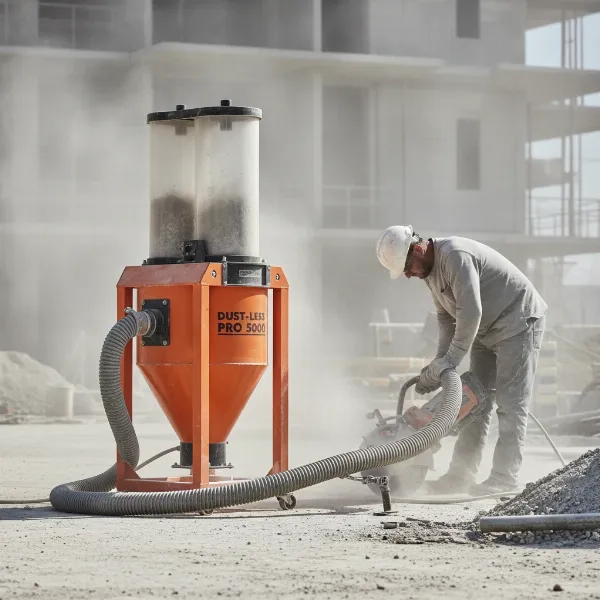 Heavy-duty dust extractor with advanced filtration system effectively managing construction site dust.
HEPA Filtration Industrial Vacuums
For construction sites where hazardous materials are present, such as lead, asbestos, or respirable crystalline silica, HEPA (High-Efficiency Particulate Air) filtration is not just an option—it’s mandatory. HEPA filters are designed to capture at least 99.97% of particles as small as 0.3 microns, which includes many dangerous microscopic particles that can cause severe respiratory issues.
The main advantage of HEPA-filtered vacuums is their unparalleled ability to ensure air quality and regulatory compliance, making them critical for worker safety. The disadvantage might be a higher initial cost and the need for careful filter maintenance or replacement to maintain efficiency. When choosing, verify that the HEPA filters are properly sealed and tested within the unit, as improper installation can compromise their effectiveness. These vacuums are indispensable for any project involving materials that generate harmful airborne particles.
Continuous Duty Industrial Vacuums
For operations that require non-stop cleaning or dust extraction over extended periods, continuous duty industrial vacuum systems are the ideal solution. These vacuums are built with robust, often three-phase motors designed to run for thousands of hours without overheating or losing suction. They are common in large industrial facilities and very large construction projects where ongoing cleanup is a necessity.
The primary benefits are their exceptional durability, reliability, and ability to handle constant, high-volume material collection without downtime. However, they come with a higher upfront cost and may require specialized electrical hookups due to their powerful motors. They are an investment in long-term efficiency and reduced maintenance in demanding, always-on scenarios.
Comparison Table of Industrial Vacuum Cleaners for Construction
To help you visualize the differences and choose wisely, here’s a comparison of common industrial vacuum types suitable for construction sites:
| Feature | Wet & Dry Vacuum | Heavy-Duty Dust Extractor | HEPA Filtration Vacuum | Continuous Duty Vacuum |
|---|---|---|---|---|
| Best For | Versatile dry/liquid cleanup | Fine dust, silica, wood chips | Hazardous materials, fine particles | 24/7 high-volume collection |
| Power (W) | 1400W – 3000W | 2000W – 4000W+ | 1800W – 3500W | 3000W – 5000W+ |
| Capacity (L) | 30L – 60L | 30L – 100L | 20L – 80L | 60L – 200L+ |
| Filtration | Multi-stage, some with HEPA option | Multi-stage, often with reverse pulse, HEPA | Mandatory HEPA (99.97% @ 0.3 microns) | Heavy-duty, often multi-stage & HEPA |
| Wet Capability | Yes | Often dry-only; some wet/dry models | Can be wet/dry compatible | Can be wet/dry compatible |
| Durability | High (steel/impact-resistant plastic) | Very High (steel) | Very High (sealed, robust) | Extremely High (industrial-grade steel) |
| Typical Price | Mid-range ($800 – $2,000) | Mid to High ($1,000 – $3,500) | Mid to High ($1,500 – $4,000) | High to Premium ($2,500 – $5,000+) |
| Key Benefits | Versatility, handles mixed debris | Superior dust capture, air quality | Essential for safety/compliance | Uninterrupted operation, extreme power |
| Considerations | Filter changes for wet/dry, tank cleaning | Specific for dust, less versatile for wet | Higher filter costs, meticulous maintenance | High upfront cost, power requirements |
Essential Criteria When Choosing an Industrial Vacuum Cleaner
Selecting an industrial vacuum cleaner for construction sites involves more than just picking a powerful machine. You need to consider specific features that enhance performance, ensure safety, and offer durability in demanding conditions.
Power and Suction
The effectiveness of an industrial vacuum cleaner on a construction site hinges significantly on its power and suction capabilities. Construction debris is often heavy and dense, requiring substantial force to lift and collect.
- Motor Wattage: Look for motors rated between 1400W for lighter industrial tasks and over 2000W for heavy-duty applications like concrete debris removal. For context, typical household vacuums are in the 500-1200W range.
- Suction Pressure (kPa): This measures the vacuum’s pulling strength. Aim for at least 20 kPa for general building site tasks, with 25-30 kPa or higher for the most demanding applications.
- Airflow (CFM): Cubic Feet per Minute indicates the volume of air the vacuum moves. Higher CFM is crucial for picking up larger debris efficiently. A balanced combination of high suction pressure and ample airflow ensures effective cleaning.
Noise Level
Construction sites are inherently noisy environments, so minimizing additional noise from equipment is beneficial for worker comfort and communication. While industrial vacuums are powerful and therefore can be loud, some models are engineered for quieter operation. Look for models with noise levels below 70 dB if noise reduction is a priority, especially in enclosed spaces or areas where other work requires clear communication. Prioritizing models with optimized acoustics can contribute to a better working environment.
Tank Capacity
Frequent emptying of a vacuum’s collection tank can be a significant disruption to workflow and productivity. Industrial vacuums for construction sites should feature generous tank capacities to minimize downtime.
- Small to Medium Sites: Tanks ranging from 30 to 60 liters might be sufficient.
- Large Operations/Heavy Debris: Consider capacities of 60 to 100 liters or more for extended runtime.
Tank construction material is also vital; stainless steel tanks offer superior durability and corrosion resistance, while robust wheeled bases with quality casters improve mobility across uneven surfaces. Easy-empty mechanisms further streamline the disposal process.
Filtration System
The quality of the filtration system is paramount for health protection on construction sites, where fine particulates can cause serious respiratory problems.
- Multi-Stage Filtration: The best industrial vacuums employ multiple layers of filtration. Pre-filters capture larger debris, main filters trap medium-sized dust, and HEPA filters capture 99.97% of particles down to 0.3 microns. Some specialized models even include ULPA filters, trapping 99.999% of particles down to 0.12 microns.
- HEPA Filters: Essential for removing hazardous respirable crystalline silica, lead, and asbestos particles. Ensure HEPA filters are properly sealed and certified.
- Filter Cleaning Systems: Automatic filter cleaning systems, such as reverse pulse technology, are game-changers. They maintain consistent suction by dislodging trapped particles, reducing the need for manual cleaning and extending filter life.
Other Features
Beyond core performance metrics, several other features contribute to the suitability and efficiency of an industrial vacuum on a construction site:
- Durability and Build Quality: Construction environments demand equipment that can withstand rough handling. Look for steel or stainless steel construction, heavy-duty wheels and casters, and reinforced, anti-static hoses that resist punctures and prevent dust clogging.
- Wet and Dry Functionality: As discussed, this versatility is crucial for handling both solid debris and liquid spills. Features like automatic shutoff for liquids and drain valves are beneficial.
- Safety Features: For combustible dust (e.g., wood dust, metal powder), ATEX-certified explosion-proof vacuums are essential to prevent sparks. Proper grounding and GFI-protected outlets are critical for electrical safety. OSHA compliance for dust management is non-negotiable.
- Hose Length and Attachments: Long, flexible hoses (20+ feet) allow greater reach, while a variety of attachments (e.g., crevice tools, floor nozzles, brush attachments) enhance versatility for different cleaning tasks.
- Tool Activation: Some models can synchronize with power tools, automatically turning on when the tool is activated, ensuring immediate dust capture at the source.
- Ergonomics: Despite their heavy-duty nature, features like comfortable handle heights, smooth-rolling wheels, and balanced weight distribution improve maneuverability and reduce operator fatigue.
Industrial Vacuum Cleaner Buying Guide
Choosing the ideal industrial vacuum cleaner for your construction site is a strategic decision that impacts safety, efficiency, and long-term costs. Follow this step-by-step guide to make an informed choice.
-
Assess Your Needs:
- Materials: What types of debris will you mostly encounter (fine dust, heavy concrete, liquids, hazardous materials, hot materials, sharp objects)? This dictates filtration and wet/dry capability.
- Usage Frequency: Will the vacuum be used intermittently for spot cleaning or continuously for large-scale dust extraction? This affects motor type and durability requirements.
- Area Size: How large is the cleaning area? This impacts required tank capacity and maneuverability.
- Regulatory Requirements: Are there specific OSHA, EPA, or industry-specific regulations regarding dust control or hazardous material handling that mandate HEPA filtration or ATEX certification?
-
Calculate Required Capacity:
- Match the tank size to the volume of debris generated and your desired emptying frequency. For significant daily waste, a 60-100+ liter tank is often recommended to reduce downtime.
-
Determine Power Requirements:
- Consider motor wattage, suction pressure (kPa), and airflow (CFM). For general industrial use, 1800-2200W, 20-25 kPa, and 150-250 CFM offer an optimal balance. Demanding applications might require higher specifications.
-
Select Appropriate Filtration:
- Standard: For general dust and debris.
- HEPA: Essential for fine particles, allergens, and hazardous materials like silica, lead, or asbestos.
- ULPA: For ultra-clean environments (less common on typical construction sites).
- Prioritize vacuums with reverse pulse cleaning for continuous high performance.
-
Consider Special Features:
- Look for durability (steel construction, reinforced hoses), wet/dry functionality, automatic filter cleaning, tool activation, variable speed control, and noise reduction if applicable.
- If dealing with combustible dust, ensure the vacuum is ATEX-certified and explosion-proof.
-
Check Accessories and Attachments:
- Ensure the vacuum comes with or offers a range of appropriate nozzles, extension wands, and specialized tools for your specific tasks (e.g., concrete grinding attachments).
-
Evaluate Warranty and Support:
- Good manufacturers stand behind their products. Look for a minimum 1-year warranty (2-3 years is better), readily available replacement parts, accessible customer service, and local service centers. This minimizes long-term operational costs and downtime.
-
Budget Considerations:
- Industrial vacuums range from a few hundred dollars to several thousand. While budget models exist, consider the total cost of ownership (TCO). A cheaper vacuum that frequently breaks or performs poorly can cost more in replacements, downtime, and health risks than a quality, higher-priced unit that lasts for years.
Reputable Industrial Vacuum Cleaner Brands
Several manufacturers have established themselves as leaders in producing high-quality industrial vacuum cleaners suitable for the demanding environment of construction sites. Here are a few prominent brands:
- Sanitmax: Known for offering professional-grade industrial vacuums with features like HEPA filtration and reverse pulse cleaning at competitive price points. Their SM100 model is often highlighted for its robust performance and value in mid-range applications.
- Nilfisk: A global leader, Nilfisk industrial vacuums are recognized for their exceptional durability, powerful performance, and advanced engineering. They offer a wide range, including ATEX-certified models for hazardous environments, though typically at a premium price.
- Shop-Vac: While offering a range of consumer vacuums, Shop-Vac also has a professional series that provides solid performance for lighter industrial applications and smaller job sites at accessible price points.
- Makita and Milwaukee: These brands are power tool giants, and their industrial extractors are popular among contractors already invested in their tool ecosystems. They offer good integration with their power tools and reliable service networks, particularly strong for construction and renovation work.
- Jfurther: Specializes in industrial vacuum solutions, with models like the JF-150T designed for heavy concrete debris and the JF-100D for specialized dust extraction with tool connectivity.
- Depureco: Offers high-performance industrial vacuums, such as the TB UP 4, ideal for large construction sites requiring continuous operation and significant debris collection.
- Kärcher: Another well-known brand, Kärcher produces professional cleaning machinery, including industrial wet/dry vacuums with powerful motors and large capacities suitable for construction.
When considering a brand, research specific models that align with your needs and review customer feedback on durability, performance, and after-sales support.
“The right industrial vacuum isn’t just about cleaning—it’s a critical tool for worker protection, regulatory compliance, and project efficiency. When viewed through this lens, the value proposition becomes much clearer.”
Conclusion
Navigating the unique challenges of construction site cleanup demands more than just a standard vacuum; it requires a specialized industrial vacuum cleaner built for performance, durability, and safety. By carefully evaluating factors such as power, tank capacity, filtration systems (especially HEPA), wet/dry capabilities, and build quality, you can make an informed decision that significantly impacts your site’s efficiency and your team’s well-being. Investing in a high-quality industrial vacuum is an investment in a safer, more productive construction environment, ensuring compliance with regulations and safeguarding against long-term health risks. Don’t settle for underpowered equipment that creates more problems than it solves.
What crucial feature will you prioritize in your next industrial vacuum cleaner to elevate your construction site’s safety and productivity?
Frequently Asked Questions
What’s the key difference between an industrial vacuum and a regular shop vac?
Industrial vacuums are engineered for continuous, heavy-duty use in harsh environments, featuring powerful motors (typically 1800W+), large steel tanks (50-100+ liters), and advanced filtration like HEPA. Shop vacs are lighter-duty, built for intermittent workshop use, with less power and basic filtration, unsuitable for the intense demands and hazardous materials found on construction sites.
How much suction power is truly needed for construction site cleanup?
For general industrial cleaning, look for vacuums with 20-25 kPa suction pressure and 150-250 CFM airflow. For demanding tasks like heavy concrete or metal chip collection, 30-50 kPa is more appropriate. It’s the balance between strong suction and high airflow that effectively picks up a range of construction debris.
Are HEPA filters always necessary for industrial vacuums on construction sites?
HEPA filters are mandatory when dealing with fine dust, hazardous materials such as silica, lead, or asbestos, or when regulatory compliance (like OSHA standards) demands specific air quality. While not strictly necessary for general, non-hazardous debris, HEPA filtration significantly improves overall air quality and protects workers’ respiratory health, making it a highly recommended feature.
How often should industrial vacuum filters be cleaned or replaced?
The frequency depends on usage intensity and filter type. Heavy daily use might require weekly filter inspection and cleaning. For systems with reverse pulse cleaning, monthly checks might suffice. HEPA filters typically need replacement every 6-12 months or when suction notably decreases, regardless of cleaning. Always follow the manufacturer’s specific guidelines.
Can an industrial vacuum handle both wet spills and dry dust effectively?
Yes, many industrial vacuums are specifically designed with wet/dry functionality, making them highly versatile for construction sites. Look for models with features like float shut-off valves to protect the motor from liquid overfill, corrosion-resistant tanks, and separate filtration systems that can handle both types of debris without compromising performance.
What is the typical lifespan of a quality industrial vacuum cleaner?
With proper maintenance, a quality industrial Vacuum Cleaner can last between 8 to 15 years, and even longer for heavy-duty units with high-hour rated motors. Factors like build quality (steel construction), motor type (brushless often last longer), usage intensity, and consistent maintenance significantly influence its lifespan.
Should I consider a cordless industrial vacuum for my construction site?
Cordless industrial vacuums are suitable for light tasks, quick spot cleaning, or highly maneuverable work where power outlets are scarce. However, their battery life (typically 20-40 minutes) and sustained suction power usually cannot match corded units for heavy, continuous industrial applications on construction sites. Corded vacuums remain the standard for demanding, all-day work.