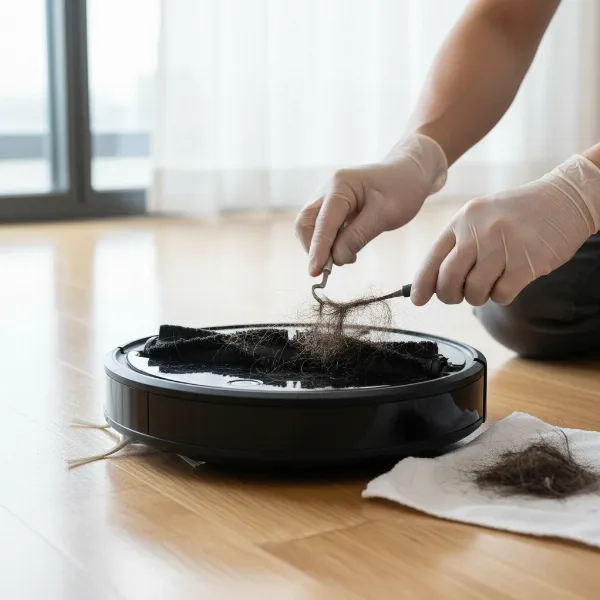
Choosing the right vacuum cleaner is more than just about powerful suction; it’s about the air you breathe after you clean. For those battling allergies, dealing with pets, or simply seeking a truly pristine home environment, the filtration system is paramount. While High-Efficiency Particulate Air (HEPA) filters have long been the gold standard, a growing interest in water filtration vacuums has sparked a critical question: are water filtration vacuums better than HEPA? This comprehensive guide dives deep into both technologies, comparing their mechanisms, benefits, drawbacks, and ultimately helping you decide which vacuum system offers the superior cleaning solution for your household.
Understanding Vacuum Cleaners and Their Purpose
Vacuum cleaners are essential household appliances designed to remove dust, dirt, and debris from various surfaces. Their primary function is to maintain cleanliness and contribute to a healthier indoor environment by extracting unwanted particles. The evolution of vacuum technology has seen significant advancements, moving from simple manual sweepers to sophisticated machines with advanced filtration systems.
The history of vacuum cleaners dates back to the late 19th century, with early models being manually operated or using complex systems of bellows. The early 20th century saw the introduction of motorized designs, making vacuuming more accessible and efficient. Over time, innovations have focused on improving suction, reducing noise, and critically, enhancing filtration to capture even the smallest, most harmful airborne particles.
Today’s market offers a diverse range of vacuum cleaners, each with unique features and filtration methods. Common types include bagged vacuums, bagless cyclonic vacuums, robotic vacuums, handheld models, and specialized systems like water filtration vacuums. Each type aims to address specific cleaning needs and preferences, with filtration technology being a key differentiator in their effectiveness, particularly for indoor air quality.
Popular Vacuum Cleaner Types and Their Filtration
The world of vacuum cleaners is vast, with various designs tailored for different cleaning scenarios. Understanding their filtration methods is key to appreciating their effectiveness.
Bagged Vacuum Cleaners
Bagged vacuums are a traditional choice, collecting dirt and debris in a disposable bag.
- Pros: Dust disposal is relatively clean as the dirt is contained within the bag. Many modern bagged vacuums incorporate multi-layered bags that offer good filtration, and some even integrate HEPA-level filtration directly into the bag. This can be beneficial for allergy sufferers as contact with dust is minimized during emptying.
- Cons: Requires continuous purchase of replacement bags, which adds to ongoing costs and creates waste. Suction can decrease as the bag fills up and airflow is restricted. Bags may sometimes harbor odors if left too long.
- Choosing the Right Bagged Vacuum: Look for models with multi-layered, allergen-sealed bags. Consider the cost and availability of replacement bags for your chosen model. Ensure the vacuum itself has a sealed system to prevent dust leakage around the bag.
|
Our Picks for the Best Vacuum cleaner in 2026
As an Amazon Associate I earn from qualifying purchases.
|
||
| Num | Product | Action |
|---|---|---|
| 1 | Shark NV352 Navigator Lift Away Upright Vacuum, Hepa Filter, Anti-Allergen Technology, Swivel Steering, Ideal for Carpet, Stairs, & Bare Floors, with Wide Upholstery & Crevice Tools, Lavender |

|
| 2 | UNINELL HOME Cordless Vacuum Cleaner, 45,000Pa/450W Stick Vacuum Cleaners for Home, 60 Mins Runtime, Self-Standing, Detachable Battery, Anti-Tangle Brush, Lightweight Wireless Vacuum for Pet Hair |
|
| 3 | Eureka NEU10AE5 Powerful Bagless Upright Vacuum Cleaner Carpet and Floor, AirSpeed Ultra-Lightweight Vacuum Cleaner, w/ Replacement Filter, Blue |
|
| 4 | Eureka PowerSpeed NEU181A Upright Vacuum Cleaner For Daily Cleaning for Pet-Owning Households , 5-Height Adjustment-Powerful Suction-Large Dust Cup-Pet Turbo Brush,Suitabe For Carpets & Hard Floors |
|
| 5 | Cordless Vacuum Cleaner, 550W 45kPa 65Mins Vacuum Cleaners for Home with LED Display, Self-Standing Stick Vacuum with Anti-Tangle Brush, Rechargeable Vacuum Cordless for Pet Hair/Carpet/Floor |
|
| 6 | Bissell CleanView Compact Turbo Upright Vacuum with Quick Release Wand, Full Size Power, Compact Size for Apartments & Dorms, 3437F |
|
| 7 | Eureka Lightweight Powerful Upright Vacuum Cleaner for Carpet and Hard Floor, PowerSpeed, New Model,Blue,black/New Model |
|
| 8 | Shark Upright Vacuum, Navigator Lift-Away Deluxe with Large Dust Cup Capacity, HEPA Filter, Swivel Steering, Upholstery Tool & Crevice Tool, Blue, NV360 |
|
| 9 | Bissell CleanView Compact Upright Vacuum, Fits in Dorm Rooms & Apartments, Lightweight with Powerful Suction and Removable Extension Wand, 3508 |
|
| 10 | MONSGA Cordless Vacuum Cleaner, 45KPa 400W Stick Vacuum for Home, 50Mins Anti-Tangled Vacuum Cleaner with Charging Dock, Light-weighted Handheld Vacuum for Pet Hair/Carpet/Floor, LED Touch Display,MV3 |
|
Bagless (Cyclonic) Vacuum Cleaners
Bagless vacuums use cyclonic technology to spin dirt out of the airflow into a clear dustbin, eliminating the need for bags.
- Pros: No ongoing cost for bags, and you can easily see when the bin needs emptying. Often utilize washable filters, reducing long-term expenses. Consistent suction is generally maintained better than with a full bag.
- Cons: Emptying the dustbin can release a cloud of dust and allergens back into the air, making them less ideal for severe allergy sufferers. Filters require regular cleaning to maintain efficiency, and these filters can sometimes clog.
- Choosing the Right Bagless Vacuum: Prioritize models with multi-stage filtration, including a true HEPA filter and a well-sealed dustbin. Consider the ease of emptying and cleaning the dustbin and filters to minimize dust exposure.
Robotic Vacuum Cleaners
Robotic vacuums autonomously navigate and clean floors, offering convenience and consistent maintenance.
- Pros: Hands-free operation, programmable schedules, and ability to clean frequently. Many high-end models feature intelligent mapping and navigation. Some models now include self-emptying dustbins.
- Cons: Limited suction power compared to full-sized vacuums. May struggle with deeply embedded dirt or large debris. Can get stuck in tricky areas. Battery life limits cleaning time.
- Choosing the Right Robotic Vacuum: Look for models with strong suction for their class, effective navigation, and comprehensive app control. For allergy sufferers, consider models with HEPA-style filters and self-emptying features to minimize contact with dust.
Handheld Vacuum Cleaners
Compact and portable, handheld vacuums are designed for quick clean-ups of small messes.
- Pros: Lightweight, easy to maneuver, and ideal for spot cleaning, car interiors, and upholstery. Many are cordless, offering ultimate flexibility.
- Cons: Limited battery life and suction power. Small dust capacities require frequent emptying. Not suitable for whole-house cleaning.
- Choosing the Right Handheld Vacuum: Assess battery life, charging time, and included attachments. Look for decent suction for quick jobs and ease of emptying.
These categories represent the foundational types, but advancements in filtration have led to specialized systems like water filtration vacuums, which stand out with their unique approach to trapping contaminants.
Water Filtration Vacuums vs. HEPA Vacuums: A Deep Dive
The core of effective vacuuming lies in its filtration system. When considering “Water Filtration Vacuums: Are They Better Than HEPA?”, it’s essential to understand how each technology works and its specific advantages and disadvantages. Both systems aim for cleaner air, but their methodologies and overall user experience differ significantly.
What is a Water Filtration Vacuum?
A water filtration vacuum, also known as a water vacuum, uses water as its primary filtering agent. Instead of bags or dry filters, these vacuums pull dust, dirt, and allergens into a water basin. The incoming air and debris are forced through this water, where particles are “wet” and trapped. This method prevents dust from recirculating back into the air.
- How it Works: Air laden with dust and debris is drawn into the vacuum and directed into a water-filled tank. As the air passes through the water, particles get saturated and trapped. The water’s surface tension and the cyclonic action often employed ensure that dust and allergens are captured and cannot escape. Cleaned air is then expelled, often passing through an additional secondary filter (sometimes a HEPA filter) for final purification.
- Benefits:
- No Dust Re-circulation: A primary advantage is that dust is permanently trapped in water, eliminating the common issue of fine particles escaping back into the air when emptying a dustbin or from minor leaks in dry filter systems.
- Consistent Suction: Unlike bagged or bagless vacuums where filters can clog and reduce suction, water filters do not clog in the same way, leading to consistent cleaning performance.
- Excellent for Allergies and Asthma: By trapping allergens like pollen, dust mites, and pet dander in water, these vacuums significantly improve indoor air quality, offering relief to allergy and asthma sufferers.
- Can Handle Wet and Dry Messes: Water vacuums are versatile and can pick up liquid spills in addition to dry debris, making them highly practical for homes with children or pets.
- Odor Neutralization: Water can effectively trap and neutralize odors, and some models allow for the addition of essential oils to freshen the air during cleaning.
- No Bags to Buy: Eliminates the ongoing cost and environmental waste associated with disposable vacuum bags.
- Drawbacks:
- Maintenance: Requires regular emptying, cleaning, and drying of the water basin after each use. If not cleaned properly, stagnant water can lead to unpleasant smells or even mold and bacteria growth.
- Weight and Bulk: The water in the basin adds significant weight, making these vacuums heavier and potentially more cumbersome to maneuver, especially on stairs.
- Not All Dust is Water Soluble: While highly effective, certain types of fine dust, like construction dust or talc, may not be perfectly wetted and trapped by water alone, potentially requiring a secondary filter.
- Initial Cost: Water filtration vacuums often have a higher upfront cost compared to conventional models.
What is a HEPA Vacuum?
HEPA stands for High-Efficiency Particulate Air. A HEPA filter is a mechanical air filter that works by forcing air through a fine mesh that traps particles. To qualify as HEPA, an air filter must satisfy certain efficiency standards.
- How it Works: A HEPA filter is typically made of a dense mat of randomly arranged fibers. As air passes through this intricate mesh, particles larger than the fibers are trapped, while smaller particles are captured through a combination of interception, impaction, and diffusion. A true HEPA filter captures 99.97% of particles as small as 0.3 microns. This includes common allergens like pollen, pet dander, mold spores, and even some bacteria and viruses.
- Benefits:
- Superior Fine Particle Filtration: HEPA filters are exceptionally effective at capturing microscopic particles that can trigger allergies and asthma.
- Improved Air Quality: By trapping a vast majority of airborne irritants, true HEPA vacuums significantly enhance indoor air quality.
- Widely Available: HEPA filtration is a common feature in many high-quality vacuum cleaners across various types (upright, canister, robot).
- Drawbacks:
- Filter Replacement: HEPA filters require regular cleaning and eventual replacement, typically every few months to a few years, depending on usage. This adds to ongoing costs and maintenance.
- Reduced Suction: As HEPA filters accumulate trapped particles, their airflow can become restricted, leading to a noticeable decrease in suction power.
- “HEPA-Type” vs. “True HEPA” vs. “Sealed HEPA”: This is a critical distinction. Many vacuums claim to have a “HEPA filter,” but if the vacuum itself is not a “sealed system,” air can leak around the filter or through unsealed parts of the vacuum body, releasing dust back into the room. A true HEPA vacuum ensures that all air passes through the filter before being expelled.
- No Liquid Pickup: Standard HEPA vacuums cannot handle wet messes, as water can damage the filter media and motor.
- Odor Limitations: While trapping particles, HEPA filters do not typically absorb or neutralize odors and gaseous compounds.
Key Differences at a Glance
| Feature | HEPA Vacuum | Water Filtration Vacuum |
|---|---|---|
| Filtration Method | Dry, fibrous filter media | Water basin |
| Particle Re-release | Possible if system is not sealed or filter clogs | Extremely low; particles trapped in water |
| Suction Consistency | Can decrease as filter clogs | Remains consistent (water does not clog) |
| Allergy Control | Excellent for fine particles (if sealed) | Excellent; traps allergens in water |
| Odor Control | Limited | Strong; water can neutralize/aromatize odors |
| Wet Pickup | No | Yes |
| Maintenance | Filter replacement, occasional cleaning | Water emptying, basin cleaning/drying after each use |
| Weight | Generally lighter | Heavier due to water |
| Mess Factor | Dust cloud when emptying (bagless) | Messy water disposal and cleaning |
This comparison reveals that while both systems are highly effective, water filtration often gains an edge in consistent performance and allergen containment due to the nature of trapping particles in liquid.
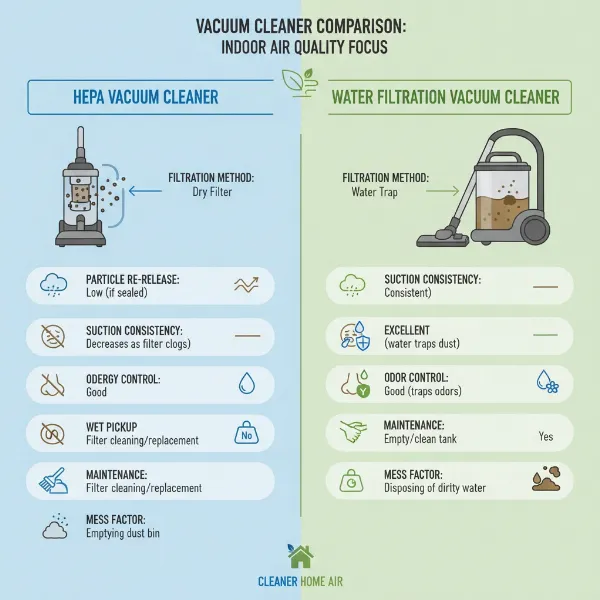 Infographic comparing features and benefits of HEPA and water filtration vacuum cleaners for home use.
Which is Better for Your Home? Cleaning Performance Comparison
Deciding whether a water filtration vacuum is better than a HEPA vacuum hinges on understanding their cleaning performance across different aspects.
Dust and Fine Particle Removal
HEPA vacuums are renowned for their ability to capture microscopic particles. A certified HEPA filter removes 99.97% of airborne particles 0.3 microns or larger. This makes them highly effective for dry dust, pet dander, and pollen. However, their performance can diminish as filters become clogged, and if the vacuum isn’t a sealed HEPA system, fine particles can escape through leaks in the housing.
Water filtration vacuums, on the other hand, boast a unique advantage in trapping dust. As air and particles are pulled through water, dust is immediately wetted and submerged, preventing it from recirculating. This means virtually no dust is released back into the air during or after cleaning. Some water vacuums, like the Sirena system, claim 99.99% particle trapping, with a backup HEPA filter catching the remaining 0.01% for 100% efficiency. This continuous trapping ensures consistent performance and leaves the air noticeably cleaner.
Deep Carpet Cleaning
For deep carpet cleaning, suction power combined with effective filtration is crucial to extract embedded dirt and allergens. HEPA vacuums, particularly powerful upright or canister models with strong brush rolls, can effectively agitate carpet fibers and pull out deeply set debris. Their efficiency, however, relies on clean filters and a well-maintained sealed system.
Water filtration vacuums often excel in deep carpet cleaning because their consistent suction isn’t compromised by clogging filters. The powerful suction combined with the water’s trapping ability ensures that embedded dirt, dust, and even pet hair are pulled into the water basin without creating dust clouds or allowing particles to escape. The moist environment can also help settle some fine particles for easier capture.
Hard Floors and Upholstery
Both HEPA and water filtration vacuums perform well on hard floors and upholstery. HEPA vacuums with appropriate attachments can effectively remove surface dust and debris without scattering.
Water filtration vacuums offer enhanced dust containment on hard surfaces. When vacuuming, there’s less chance of fine dust being blown around or escaping, making for a cleaner sweep. For upholstery, their ability to thoroughly trap allergens and odors is a significant benefit. Furthermore, the wet pickup capability of water vacuums makes them superior for accidental spills on hard floors or even damp cleaning of certain upholstery types.
Ultimately, while HEPA vacuums are highly efficient for fine particle removal when properly sealed and maintained, water filtration vacuums often offer more consistent performance, superior dust containment, and versatility in handling wet messes, which can translate to a more complete cleaning experience, especially in homes with high cleaning demands.
Allergy and Air Quality Comparison
For individuals suffering from allergies or asthma, or simply those prioritizing pristine indoor air quality, the vacuum’s filtration system is arguably its most critical feature. Both HEPA and water filtration systems are marketed for these benefits, but they achieve them differently.
HEPA Vacuum Considerations
HEPA filters are specifically designed to capture tiny airborne particles, making them invaluable for allergy sufferers. They trap common irritants such as pollen, pet dander, mold spores, and dust mite droppings before they are recirculated. However, several factors can impact their real-world effectiveness:
- Filter Condition: HEPA filters need regular cleaning and timely replacement. A clogged filter will reduce airflow and filtration efficiency.
- Sealed System is Key: A vacuum having “a HEPA filter” is not the same as being a “sealed HEPA vacuum.” Many vacuums leak air through unsealed joints or around the filter housing, allowing unfiltered dust to escape back into the environment. A true sealed HEPA system ensures all incoming air passes through the filter.
- Emptying Dustbins: For bagless HEPA vacuums, emptying the dustbin can release a burst of concentrated allergens and fine dust back into the air, negating some of the filtration benefits.
Water Filtration Advantages
Water filtration vacuums offer a distinct advantage for allergy and asthma sufferers primarily because of how they trap contaminants.
- Permanent Trapping: Dust, pollen, pet dander, and other allergens are drawn into the water and immediately submerged. This physical trapping prevents them from becoming airborne again, either during vacuuming or upon disposal.
- No Dust Clouds During Disposal: When it’s time to empty the vacuum, you simply pour out dirty water, eliminating the dust cloud associated with emptying bags or dry bins. This greatly reduces exposure to allergens for the user.
- Air Purification: Many water filtration vacuums also function as air purifiers, continuously cleaning the air and settling dust particles in the room as they operate.
- Humidity Benefits: In dry climates, the slight increase in humidity expelled by a water vacuum can be a benefit, helping to settle airborne particles.
- Combined Filtration: Many high-end water filtration systems include a secondary HEPA filter. This combination provides a robust defense, with water handling the bulk of particles and the HEPA filter capturing any remaining microscopic elements, ensuring maximum air purification.
Conclusion for Allergies: For individuals with severe allergies or asthma, water filtration vacuums often provide a superior solution due to their ability to permanently trap allergens in water and eliminate dust re-emission during disposal. When combined with a backup HEPA filter in a well-designed system, they offer unparalleled air cleaning capabilities.
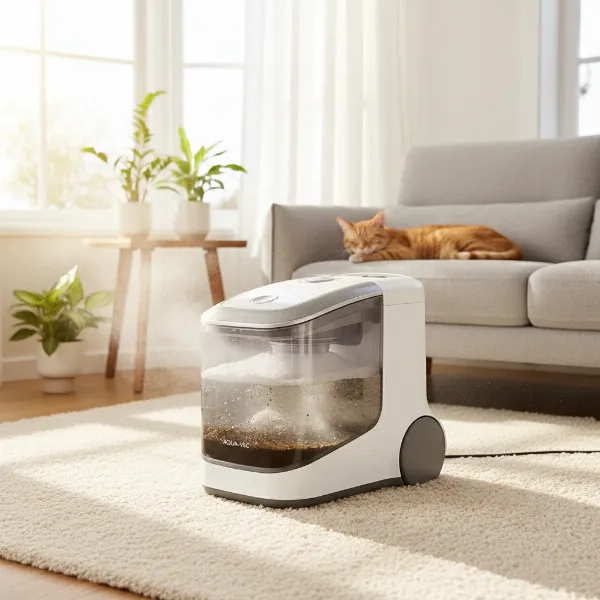 Water filtration vacuum actively cleaning a living room with a cat nearby, demonstrating fresh, clean air.
Pet Hair and Odor Control
For homes with furry friends, managing pet hair and odors is a constant challenge. Both HEPA and water filtration vacuums play a role, but their effectiveness differs.
HEPA Vacuums for Pets
HEPA vacuums are excellent at collecting pet hair and dander from various surfaces. Their strong suction combined with effective filtration means that allergens shed by pets, which are often microscopic, are captured and not recirculated. This is a significant benefit for pet owners who also suffer from allergies.
However, HEPA vacuums can struggle with odors. While they remove the particles carrying odors, they typically don’t neutralize the gaseous compounds responsible for pet smells. Also, pet hair can quickly clog filters or fill bags, leading to a decrease in suction and requiring more frequent maintenance.
Water Filtration Vacuums for Pets
Water filtration vacuums are particularly well-suited for pet owners.
- Superior Pet Hair and Dander Capture: The water basin effectively traps pet hair and dander, preventing it from becoming airborne. This is especially beneficial as pet dander is a common and potent allergen.
- Odor Neutralization: Water naturally helps to trap and neutralize pet odors. The ability to add deodorizers or essential oils to the water further enhances this benefit, leaving the home smelling fresh and clean after vacuuming.
- Wet Mess Capability: A major advantage for pet owners is the ability to easily clean up liquid pet messes, such as tracked-in paw prints, accidents, or spilled water bowls, without damaging the vacuum.
- Consistent Performance: Unlike dry filters that can become clogged with pet hair, water filtration maintains consistent suction, even when dealing with large amounts of pet fur.
For homes with pets, water filtration vacuums often offer a more comprehensive solution, not only efficiently removing pet hair and dander but also effectively tackling odors and wet messes, contributing to a significantly cleaner and fresher living environment.
Maintenance and Long-Term Use
The long-term usability and cost-effectiveness of a vacuum cleaner are heavily influenced by its maintenance requirements and durability. Both HEPA and water filtration systems have distinct maintenance routines.
HEPA Vacuum Maintenance
HEPA vacuums require specific maintenance to ensure their continued effectiveness:
- Filter Replacement: The primary maintenance task is cleaning and eventually replacing the HEPA filter. Depending on usage and the manufacturer’s recommendations, filters may need to be cleaned every few months and replaced every one to three years. These replacements can be an additional cost, with prices varying significantly by brand.
- Pre-filter Cleaning: Many HEPA vacuums also have washable pre-filters that need more frequent cleaning to protect the main HEPA filter.
- Seals and Housing: For a true HEPA system, it’s crucial to inspect seals and housing for wear and tear, as any leaks can compromise filtration effectiveness.
- Dust Bag/Bin Emptying: Bagged HEPA vacuums require regular bag changes, while bagless models need their dustbins emptied frequently.
Neglecting HEPA filter maintenance can lead to reduced suction, decreased filtration efficiency, and potentially shorten the lifespan of the vacuum’s motor.
Water Filtration Vacuum Maintenance
Water filtration vacuums have a different, albeit consistent, maintenance routine:
- Water Disposal and Basin Cleaning: The most critical task is to empty the dirty water and clean the water basin after every use. This prevents odors from developing and inhibits the growth of mold or bacteria. The basin must then be thoroughly dried before storage to ensure hygiene.
- No Filter Replacements (Primary Filter): Since water is the primary filter, there are no expensive filter replacements needed for the main filtration system, which can save money over time.
- Secondary Filter (if present): If the water vacuum has a secondary HEPA filter, this will still require occasional cleaning or replacement, but usually less frequently than in a dedicated dry HEPA vacuum, as the water captures the bulk of the particles.
- Motor/Separator Cleaning: Some models may require periodic cleaning of the motor separator, which is the component that agitates the water to trap particles.
While the daily ritual of emptying and cleaning the water basin might be perceived as a chore, it ensures the vacuum is always operating with fresh filtration and prevents the accumulation of allergens or odors within the machine itself. This simplicity in concept—no bags, consistent performance—often appeals to users seeking a reliable, long-term cleaning solution.
“The greatest benefit of a water filtration vacuum lies in its consistent performance and ability to eliminate dust re-emission. You start every cleaning session with a fresh filter, ensuring optimal air quality from beginning to end.” – Alex Chen, Certified Indoor Air Quality Specialist
In terms of long-term reliability and consistent performance, water filtration systems often demonstrate an advantage because their core filtration method (water) doesn’t degrade or clog in the same way traditional filters do. This can lead to a longer operational life and less frequent need for part replacements compared to some HEPA-only systems.
Buying Guide: Choosing the Right Vacuum for You
Selecting the ideal vacuum cleaner requires a careful assessment of your specific needs, living environment, and budget. When weighing water filtration against HEPA, consider the following criteria to make an informed decision.
Determine Your Needs
- Allergies or Asthma: If anyone in your household suffers from severe allergies or asthma, water filtration vacuums (especially those with a backup HEPA filter) offer significant advantages in trapping allergens and preventing their re-release. A sealed HEPA vacuum is also an excellent choice, but ensure it’s truly sealed.
- Pets: For pet owners, water filtration vacuums excel at picking up pet hair, dander, and neutralizing odors, plus they can handle wet messes. HEPA vacuums are good for dander but less so for odors and liquids.
- Type of Debris: If you frequently deal with wet spills in addition to dry dust, a water filtration vacuum is the clear winner due to its wet pickup capability. For purely dry messes and fine dust, both can be effective.
- Frequency of Use: If you vacuum daily, consider the convenience of emptying. Water vacuums require daily basin cleaning, while HEPA vacuums might need filter cleaning/replacement less frequently but emptying dry bins can create dust.
- Type of Flooring: Both systems perform well on various floor types. For deep carpets, strong suction from either type is beneficial.
Set Your Budget
Both water filtration vacuums and high-quality sealed HEPA vacuums can represent a significant initial investment.
- Initial Cost: Water filtration vacuums often have a higher upfront cost. Top-tier HEPA vacuums (especially sealed systems) can also be expensive.
- Long-term Costs: With water vacuums, you save on replacement bags and primary filters. With HEPA vacuums, budget for periodic HEPA filter replacements.
Research Brands and Models
Investigate reputable brands known for quality and customer satisfaction in both categories. For water filtration, brands like Sirena and Rainbow are well-known. For HEPA, look into brands that specifically market “sealed HEPA” systems, such as Miele, Sebo, or Dyson.
- Read Reviews: Look for unbiased reviews and comparisons from other users, especially those with similar needs (e.g., pet owners, allergy sufferers).
- Check Certifications: For HEPA vacuums, verify that they meet the true HEPA standard (99.97% of particles 0.3 microns). For water vacuums, look for certifications related to allergy friendliness if available.
Experience the Product (If Possible)
If feasible, visit a local store to physically interact with the vacuums.
- Assess Weight and Maneuverability: A water vacuum’s weight can be a significant factor. Test how easy it is to push, pull, and carry.
- Ease of Use and Maintenance: Understand the process of filling, emptying, and cleaning the water basin or replacing/cleaning HEPA filters. Consider which routine fits your lifestyle.
- Noise Level: Some vacuums can be quite loud. Check the decibel ratings or listen to them in operation if possible.
Compare Prices and Warranties
- Shop Around: Prices can vary between retailers and online stores. Look for deals and promotions.
- Warranty: A good warranty indicates manufacturer confidence in the product’s durability. Given the investment, a comprehensive warranty (e.g., 5-10 years) is a valuable consideration.
Choosing between a water filtration vacuum and a HEPA vacuum ultimately comes down to your personal priorities for cleanliness, air quality, convenience, and maintenance. By thoroughly evaluating these criteria, you can select the vacuum cleaner that best meets your household’s unique demands.
Reputable Vacuum Cleaner Brands
When investing in a vacuum cleaner, especially one with advanced filtration, opting for a reputable brand is crucial for reliability and performance. Here are some well-regarded brands in the vacuum cleaner market, with a brief overview of their strengths, particularly concerning filtration:
- Dyson: Known for innovative cyclonic technology and powerful suction. Many Dyson models incorporate advanced filtration, including HEPA filters, designed to capture fine particles without losing suction. They are often praised for their bagless convenience but some users find them louder and filter maintenance can be a point of consideration.
- Electrolux: A long-standing brand offering a range of vacuums, from traditional bagged to modern bagless. Many Electrolux models, particularly their canister vacuums, feature sealed systems and HEPA filtration, making them a solid choice for allergy sufferers. They are generally known for good performance and durability.
- Philips: Offers a variety of vacuum cleaners, including bagless and bagged options, with a focus on ease of use and effective dust capture. Many Philips models incorporate HEPA 13 or higher filtration, ensuring excellent air purification. They often balance power with quieter operation.
- Miele: Renowned for premium quality, exceptional durability, and superior filtration. Miele bagged canister vacuums are often cited as the gold standard for allergy and asthma sufferers due to their multi-stage sealed HEPA filtration systems and high-quality dustbags that lock allergens in. They come with a higher price tag but are built to last.
- Sebo: Another top-tier brand, particularly favored by those with allergies or pets. Sebo vacuums, both upright and canister, are engineered with hospital-grade, sealed HEPA filtration systems. They are robust, user-friendly, and highly effective at maintaining indoor air quality, though they also represent a premium investment.
- Xiaomi: A newer player in the global market, known for offering smart home devices, including robotic and cordless stick vacuums, often at competitive price points. Many Xiaomi vacuums incorporate HEPA-style or multi-cyclonic filtration, aiming to provide good air purification for their category. They offer good value but may not match the specialized filtration of premium brands.
- Sirena: A notable brand specializing in water filtration vacuums. Sirena vacuums are designed to trap dirt and allergens permanently in water, often incorporating a secondary HEPA filter for ultimate air purification. They are praised for consistent suction, odor neutralization, and wet pickup capability, making them highly suitable for allergy and pet-owning households. Their unique system requires diligent water basin cleaning but eliminates the need for disposable bags and primary filters.
- Rainbow: Another iconic brand in the water filtration vacuum market, known for its robust construction and comprehensive cleaning systems. Rainbow vacuums use a water basin to trap dirt and feature a separator that effectively removes particles from the air. Like Sirena, they are strong contenders for allergy and pet relief, offering deep cleaning and air purification, but also require diligent water basin maintenance.
When considering any brand, especially for advanced filtration, always look beyond general claims and verify the specific filtration standards (e.g., “True HEPA” or “Sealed System”) and user reviews for real-world performance.
Conclusion
The debate between water filtration vacuums and HEPA vacuums ultimately centers on defining “better” according to individual needs. Both technologies offer significant advantages over conventional Vacuum Cleaners in enhancing indoor air quality and tackling microscopic pollutants.
HEPA vacuums excel at capturing minute dry particles, making them a powerful tool for allergy and asthma sufferers, provided they are sealed systems to prevent leakage. However, they demand diligent filter replacement and can struggle with consistent suction as filters clog, while also being unable to handle wet messes or effectively neutralize odors.
Water filtration vacuums, on the other hand, provide a unique and compelling solution by permanently trapping dirt, allergens, and odors in water. This ensures consistent suction, eliminates dust re-emission during disposal, and offers the versatility of wet pickup. While they require meticulous post-use cleaning of the water basin and can be heavier, their benefits for severe allergies, pet hair, and overall air freshness are often unparalleled.
For homes prioritizing maximum air purification, consistent performance, and the ability to handle both wet and dry messes without re-circulating dust, a water filtration vacuum, particularly one featuring a backup HEPA filter, often presents the superior choice. This combination leverages the strengths of both systems, offering comprehensive filtration and a noticeably cleaner, fresher living environment.
What matters most to your home’s health – consistent, mess-free dust trapping, or the convenience of dry disposal?
Frequently Asked Questions
Are water filtration vacuums better for allergies than HEPA?
Water filtration vacuums are often considered superior for allergies because they trap allergens permanently in water, preventing re-release into the air during vacuuming or disposal. Many models also include a backup HEPA filter for ultimate efficiency.
Do water filtration vacuums require more maintenance?
Water vacuums require emptying and thoroughly cleaning the water basin after each use to prevent odors, mold, and bacteria. While this is a daily ritual, it eliminates the need for buying and replacing expensive bags or dry filters, which HEPA vacuums often require.
Can water filtration vacuums pick up liquids?
Yes, a significant advantage of water filtration vacuums is their ability to safely and effectively pick up liquid spills, making them highly versatile for homes with children, pets, or frequent accidents.
What is the difference between a “HEPA filter” and a “sealed HEPA vacuum”?
A “HEPA filter” is a component that meets the HEPA standard. A “sealed HEPA vacuum” is a complete system where all incoming air passes through the HEPA filter without leaking through other parts of the vacuum, ensuring maximum filtration efficiency. Only sealed HEPA systems provide true HEPA benefits.
Do water vacuums make the air humid?
Yes, water filtration vacuums can slightly increase the humidity in a room as clean, moistened air is expelled. This can be beneficial in dry climates or during winter, but generally, the effect is subtle and not excessive.
Are water filtration vacuums heavy?
Due to the water in their collection basin, water filtration vacuums tend to be heavier and bulkier than many traditional dry vacuums. This can affect maneuverability, especially when cleaning stairs or moving between rooms.
How often should HEPA filters be replaced?
The replacement frequency for HEPA filters varies by manufacturer and usage, typically ranging from every few months for heavily used vacuums to every two to three years for residential use. Regular cleaning of pre-filters can extend the life of the main HEPA filter.