For decades, the humble vacuum cleaner has been an indispensable tool in maintaining a clean home. Yet, the persistent issue of diminishing suction power as dust bags fill or filters clog was a common frustration. Enter cyclonic technology—a revolutionary approach that transformed the vacuum cleaner industry. This article delves deep into the fascinating science behind cyclonic dust separation, explaining how it works, its significant advantages, and what to consider when choosing a vacuum cleaner equipped with this innovative system. We’ll uncover how this smart engineering ensures consistent cleaning performance, making your home truly spotless.
An Overview of Vacuum Cleaners and Cyclonic Technology
Vacuum cleaners operate on a simple principle: a motor drives a fan, creating a partial vacuum that sucks in air, along with dust and debris, through a nozzle. Historically, this air then passed through a bag or a series of filters, trapping the dirt. While effective to a degree, this method often led to clogging, which reduced airflow and, consequently, suction power.
Cyclonic technology, however, introduced a paradigm shift. Rather than relying solely on porous bags or filters, it harnesses the power of centrifugal force to separate dust particles from the air. Inspired by industrial cyclone separators used in sawmills and factories to remove sawdust, this innovative method was adapted for household vacuum cleaners, most notably by James Dyson in the late 20th century. The core idea is to spin the air at high speeds, forcing heavier dust particles outwards and down into a collection bin, allowing cleaner air to pass through to the motor and final filters.
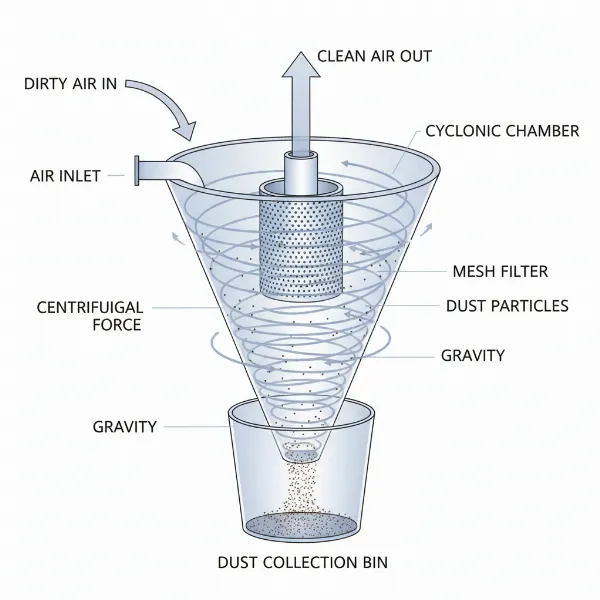 Diagram illustrating the internal workings of a cyclonic vacuum cleaner separating dust.
How Cyclonic Technology Works: The Science of Separation
The brilliance of cyclonic technology lies in its elegant application of physics to solve a practical problem.
The Principle of Cyclonic Separation
|
Our Picks for the Best Vacuum cleaner in 2026
As an Amazon Associate I earn from qualifying purchases.
|
||
| Num | Product | Action |
|---|---|---|
| 1 | Bissell CleanView Compact Upright Vacuum, Fits in Dorm Rooms & Apartments, Lightweight with Powerful Suction and Removable Extension Wand, 3508 |

|
| 2 | Shark Upright Vacuum, Navigator Lift-Away Deluxe with Large Dust Cup Capacity, HEPA Filter, Swivel Steering, Upholstery Tool & Crevice Tool, Blue, NV360 |
|
| 3 | Eureka NEU10AE5 Powerful Bagless Upright Vacuum Cleaner Carpet and Floor, AirSpeed Ultra-Lightweight Vacuum Cleaner, w/ Replacement Filter, Blue |
|
| 4 | Shark NV352 Navigator Lift Away Upright Vacuum, Hepa Filter, Anti-Allergen Technology, Swivel Steering, Ideal for Carpet, Stairs, & Bare Floors, with Wide Upholstery & Crevice Tools, Lavender |
|
| 5 | UNINELL HOME Cordless Vacuum Cleaner, 45,000Pa/450W Stick Vacuum Cleaners for Home, 60 Mins Runtime, Self-Standing, Detachable Battery, Anti-Tangle Brush, Lightweight Wireless Vacuum for Pet Hair |
|
| 6 | Eureka Lightweight Powerful Upright Vacuum Cleaner for Carpet and Hard Floor, PowerSpeed, New Model,Blue,black/New Model |
|
| 7 | Cordless Vacuum Cleaner, 550W 45kPa 65Mins Vacuum Cleaners for Home with LED Display, Self-Standing Stick Vacuum with Anti-Tangle Brush, Rechargeable Vacuum Cordless for Pet Hair/Carpet/Floor |
|
| 8 | Bissell CleanView Compact Turbo Upright Vacuum with Quick Release Wand, Full Size Power, Compact Size for Apartments & Dorms, 3437F |
|
| 9 | MONSGA Cordless Vacuum Cleaner, 45KPa 400W Stick Vacuum for Home, 50Mins Anti-Tangled Vacuum Cleaner with Charging Dock, Light-weighted Handheld Vacuum for Pet Hair/Carpet/Floor, LED Touch Display,MV3 |
|
| 10 | Eureka PowerSpeed NEU181A Upright Vacuum Cleaner For Daily Cleaning for Pet-Owning Households , 5-Height Adjustment-Powerful Suction-Large Dust Cup-Pet Turbo Brush,Suitabe For Carpets & Hard Floors |
|
At the heart of a cyclonic vacuum cleaner is the cyclone chamber. As dusty air enters this chamber, it is directed to swirl rapidly in a powerful vortex, much like a miniature tornado. This rapid rotation creates an intense centrifugal force. Just as a spinning carnival ride pushes you against its wall, this force pushes heavier dust and dirt particles outwards towards the walls of the cyclone chamber.
The Journey of Air and Dust
As the air continues to spiral downwards, the heavier particles lose momentum and gravity pulls them to the bottom of the cone, where they fall into a transparent dust collection bin. The now cleaner, lighter air, freed from most of the larger debris, then rises through the center of the vortex and exits the main cyclone chamber. This initial separation significantly reduces the load on subsequent filters, maintaining strong airflow.
Single vs. Multi-Cyclonic Systems
Early cyclonic vacuum cleaners often featured a single, large cyclone. While effective, they were primarily good at separating larger debris. Modern advancements have led to multi-cyclonic technology, which employs several smaller cyclones working in parallel or series. These smaller cyclones generate even stronger centrifugal forces, capable of separating much finer dust particles and microscopic allergens that a single, larger cyclone might miss. This multi-stage separation ensures that an even greater percentage of particulate matter is removed before the air reaches the final HEPA filters, which then trap the absolute finest impurities.
Advantages of Cyclonic Vacuum Cleaners
The adoption of cyclonic technology brought numerous benefits that significantly improved the user experience and cleaning effectiveness.
Consistent Suction Power
Perhaps the most celebrated advantage of cyclonic vacuum cleaners is their ability to maintain consistent suction power. In traditional bagged vacuums, as the bag fills, air has a harder time passing through the clogged pores, leading to a noticeable drop in suction. With cyclonic separation, dust is spun out of the airflow and collected in a bin, meaning the air path remains relatively unobstructed. This ensures that the vacuum performs with virtually undiminished power throughout the cleaning session, until the dust bin is full.
Bagless Convenience and Cost Savings
Cyclonic vacuums are inherently bagless. Instead of discarding and replacing disposable bags, users simply empty a reusable dust bin directly into the trash. This not only offers immense convenience but also translates into significant long-term cost savings, as there’s no need to purchase replacement bags. It’s also a more environmentally friendly option, reducing waste.
Enhanced Filtration and Air Quality
By removing the majority of dust and debris before the air reaches the final filters, cyclonic technology extends the life of these filters and improves their overall effectiveness. Many cyclonic vacuum cleaners incorporate advanced filtration systems, often including HEPA (High-Efficiency Particulate Air) filters. These filters are crucial for trapping microscopic allergens, pollen, pet dander, and other irritants, releasing cleaner exhaust air back into your home. This makes cyclonic vacuums particularly beneficial for households with allergy sufferers or pets.
 A bright, clean home interior with fresh, clear air, suggesting improved air quality.
“The ingenuity of cyclonic separation lies in its ability to preemptively address filter clogging, which was once the Achilles’ heel of vacuum performance. It’s a testament to how intelligent design can fundamentally improve everyday appliances.” – Dr. Eleanor Vance, Environmental Engineering Specialist
Potential Considerations and Maintenance
While cyclonic technology offers numerous advantages, it’s also important to be aware of certain aspects and maintenance requirements.
Noise Levels and Design
Some cyclonic vacuum cleaners, particularly those with powerful motors and complex multi-cyclone systems, can be louder than their traditional counterparts due to the high-speed air movement required for separation. Manufacturers are continually working to mitigate noise through improved design and insulation, but it’s a factor to consider, especially if you live in an apartment or prefer quiet appliances.
Emptying and Filter Care
While bagless, emptying the dust bin of a cyclonic vacuum can sometimes be a dusty affair, especially if you’re sensitive to airborne particles. It’s often recommended to empty the bin outdoors or directly into a trash can with a liner. Furthermore, even with cyclonic separation, the washable filters will still need periodic cleaning to ensure optimal performance and longevity. Regular rinsing and drying of these filters are crucial to maintain the vacuum’s efficiency and air quality benefits.
Cyclonic vs. Traditional Filtration: A Comparative Look
To highlight the impact of cyclonic technology, here’s a comparison with traditional bagged or single-stage filtered vacuum systems:
| Feature | Cyclonic System | Traditional Bagged/Filtered System |
|---|---|---|
| Suction Consistency | Maintains strong, consistent suction as the dust bin fills. | Suction power can diminish significantly as the bag/filter clogs. |
| Filtration Mechanism | Primarily centrifugal force separates dust; secondary filters capture fine particles. | Relies on a porous bag or filter media to trap all dust. |
| Maintenance | Empty dust bin regularly; wash and dry filters periodically. | Replace bags when full; clean or replace filters periodically. |
| Bag Requirement | Bagless; uses a reusable dust bin. | Requires disposable bags (unless it’s a bagless with standard filters). |
| Allergy Friendliness | Excellent; multi-cyclone systems and HEPA filters capture fine allergens effectively. | Can be good with HEPA bags/filters, but dust release during bag change is common. |
| Initial Cost | Often higher due to advanced technology and engineering. | Generally lower. |
| Running Cost | Very low (no bags to buy). | Ongoing cost for replacement bags and sometimes filters. |
Choosing a Cyclonic Vacuum Cleaner: Key Factors
When investing in a vacuum cleaner with cyclonic technology, several factors should guide your decision to ensure you select the best fit for your home and needs.
Suction Power and Motor Efficiency
Look beyond just wattage. A vacuum cleaner with excellent cyclonic separation will maintain high suction even with a moderately powerful motor. Consider models that specify “constant suction” or boast advanced multi-cyclonic stages. Higher air watts (a measure of effective suction power at the nozzle) can be a more useful indicator than motor wattage alone.
Filtration Systems (HEPA)
For maximum air quality, especially if anyone in your household suffers from allergies or asthma, prioritize models that feature a sealed system and a true HEPA filter. The combination of efficient cyclonic separation and a high-quality HEPA filter ensures that nearly all microscopic particles are captured and not recirculated into your indoor air.
Dust Bin Capacity and Ease of Emptying
Consider the size of your home and how frequently you clean. Larger dust bins mean less frequent emptying, which can be convenient for bigger spaces. Crucially, assess how easy and hygienic it is to empty the bin. Look for designs that allow for quick, one-touch emptying without requiring you to get your hands dirty.
“The true measure of a great cyclonic vacuum isn’t just its ability to suck up dirt, but how effectively it keeps that dirt contained and prevents it from ever reaching your lungs. A well-designed system makes all the difference.” – Michael Chen, Product Design Engineer at PureClean Innovations
Ergonomics and Accessories
Evaluate the vacuum cleaner’s weight, maneuverability, and overall design. Is it comfortable to use for extended periods? Does it come with attachments suitable for various cleaning tasks, such as upholstery tools, crevice nozzles, and pet hair brushes? The right accessories can significantly enhance the versatility and effectiveness of your cyclonic vacuum.
Leading Brands Utilizing Cyclonic Technology
Many reputable brands have embraced and innovated within cyclonic technology, offering a wide range of models.
- Dyson: As the pioneer of the bagless cyclonic vacuum, Dyson remains a leader, known for its powerful, often futuristic designs and continuous innovation in multi-cyclone technology.
- Shark: Offers a popular range of cyclonic vacuums known for their strong suction, versatility (often converting from upright to handheld), and more accessible price points.
- Bissell: Provides a variety of cyclonic vacuum cleaners, including models specifically designed for pet owners, focusing on powerful suction and specialized pet tools.
- Electrolux and Philips: These established appliance brands also feature cyclonic models, often combining reliable performance with elegant designs and user-friendly features.
- Xiaomi and Roborock: In the realm of robot vacuums, many advanced models from these brands now incorporate cyclonic-style pre-separation or powerful suction systems that mimic cyclonic principles to minimize filter clogging.
These brands continually refine their cyclonic systems, striving for greater efficiency, quieter operation, and enhanced user convenience.
Conclusion
Cyclonic technology has irrevocably changed the landscape of vacuum cleaning, moving beyond the limitations of traditional filtration to offer a more efficient, consistent, and hygienic cleaning experience. By harnessing the fundamental principles of centrifugal force, these vacuum cleaners ensure unwavering suction power, eliminate the need for costly bags, and significantly improve indoor air quality through superior dust and allergen separation. While considerations like noise and bin emptying exist, the benefits of owning a cyclonic vacuum cleaner are undeniable. When choosing your next cleaning companion, understanding how this technology works empowers you to select a device that not only picks up dirt but truly revolutionizes your approach to a spotless home.
Are you ready to experience the cyclonic difference in your cleaning routine?
Frequently Asked Questions
How does multi-cyclonic technology improve upon single-cyclone systems?
Multi-cyclonic technology utilizes numerous smaller cyclones, each generating a more intense centrifugal force than a single large cyclone. This allows for the separation of finer dust particles and microscopic allergens, leading to significantly improved filtration, even more consistent suction, and cleaner exhaust air, making it superior for tackling very fine dust and common allergens.
Do cyclonic vacuum cleaners ever lose suction?
While cyclonic vacuum cleaners are renowned for maintaining consistent suction, they can eventually lose some effectiveness if the dust bin becomes completely full, or if the internal filters are not cleaned or replaced as recommended. The primary filters, though protected by the cyclonic action, still require occasional maintenance to ensure optimal airflow and performance.
Are cyclonic vacuum cleaners better for people with allergies?
Yes, cyclonic vacuum cleaners are generally considered excellent for allergy sufferers. Their efficient multi-stage separation process, combined with often standard-issue HEPA filters and sealed systems, effectively traps dust mites, pollen, pet dander, and other microscopic allergens within the vacuum, preventing them from being recirculated into the air you breathe.