Choosing the right vacuum cleaner can feel like a quest for the holy grail of cleanliness, especially when faced with two titans of German engineering: Sebo and Miele. Both brands have carved out reputations for producing high-quality, durable, and effective machines, often commanding a premium price for their promise of pristine floors and lasting performance. But which one truly stands supreme in this battle of the German vacuum giants? If you’re weighing the investment in a top-tier cleaning companion, understanding the nuanced differences between Sebo and Miele is crucial to making a decision that perfectly aligns with your home, lifestyle, and cleaning priorities.
An Overview of Vacuum Cleaners
A vacuum cleaner is an essential household appliance designed to remove dirt, dust, and debris from floors, carpets, and other surfaces using suction. Its invention revolutionized home cleaning, moving beyond manual sweeping and dusting to a more efficient and hygienic method.
The history of vacuum cleaners dates back to the late 19th century, evolving from manual carpet sweepers to elaborate motorized systems. Early models were bulky and often required multiple operators, but technological advancements quickly led to more compact, powerful, and user-friendly designs. This progression paved the way for the sophisticated machines we know today, continually integrating new features for enhanced performance and convenience.
Modern vacuum cleaners come in various forms to suit diverse cleaning needs. These include traditional upright vacuum cleaners, known for their powerful brush rolls ideal for carpets; canister vacuum cleaners, which offer greater maneuverability and versatility with various attachments for different surfaces; robot vacuum cleaners, designed for autonomous cleaning schedules; and handheld vacuum cleaners, perfect for quick clean-ups and small messes. Each type offers distinct advantages, catering to specific cleaning challenges and preferences.
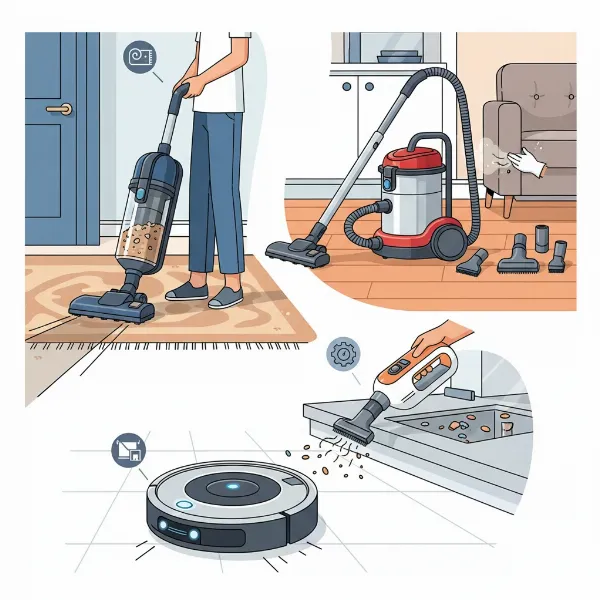 Illustration showing different types of modern vacuum cleaners for various cleaning needs.
Popular Vacuum Cleaner Types: A Deep Dive
The market offers a wide array of vacuum cleaner types, each with unique characteristics. Understanding these can help you better appreciate where Sebo and Miele fit into the landscape of high-performance cleaning.
Bagged Vacuum Cleaners
Bagged vacuums collect dirt and debris into a disposable bag, which is then sealed and discarded.
- Pros: Excellent for allergy sufferers as the sealed bag prevents dust and allergens from re-entering the air during disposal. They often provide superior filtration and require less frequent filter cleaning compared to bagless models. The Sebo Airbelt D4 and Miele Complete C3 are prime examples of high-performance bagged canister vacuums.
- Cons: Requires regular purchase and replacement of bags, adding to the ongoing cost. Suction power can decrease as the bag fills up.
- How to Choose: Ideal for homes with allergy sufferers or pets. Look for models with large bag capacities to reduce replacement frequency and those with multi-layer filtration systems.
|
Our Picks for the Best Vacuum cleaner in 2026
As an Amazon Associate I earn from qualifying purchases.
|
||
| Num | Product | Action |
|---|---|---|
| 1 | Eureka Lightweight Powerful Upright Vacuum Cleaner for Carpet and Hard Floor, PowerSpeed, New Model,Blue,black/New Model |

|
| 2 | Eureka NEU10AE5 Powerful Bagless Upright Vacuum Cleaner Carpet and Floor, AirSpeed Ultra-Lightweight Vacuum Cleaner, w/ Replacement Filter, Blue |
|
| 3 | MONSGA Cordless Vacuum Cleaner, 45KPa 400W Stick Vacuum for Home, 50Mins Anti-Tangled Vacuum Cleaner with Charging Dock, Light-weighted Handheld Vacuum for Pet Hair/Carpet/Floor, LED Touch Display,MV3 |
|
| 4 | Bissell CleanView Compact Turbo Upright Vacuum with Quick Release Wand, Full Size Power, Compact Size for Apartments & Dorms, 3437F |
|
| 5 | Shark Upright Vacuum, Navigator Lift-Away Deluxe with Large Dust Cup Capacity, HEPA Filter, Swivel Steering, Upholstery Tool & Crevice Tool, Blue, NV360 |
|
| 6 | Cordless Vacuum Cleaner, 550W 45kPa 65Mins Vacuum Cleaners for Home with LED Display, Self-Standing Stick Vacuum with Anti-Tangle Brush, Rechargeable Vacuum Cordless for Pet Hair/Carpet/Floor |
|
| 7 | Eureka PowerSpeed NEU181A Upright Vacuum Cleaner For Daily Cleaning for Pet-Owning Households , 5-Height Adjustment-Powerful Suction-Large Dust Cup-Pet Turbo Brush,Suitabe For Carpets & Hard Floors |
|
| 8 | UNINELL HOME Cordless Vacuum Cleaner, 45,000Pa/450W Stick Vacuum Cleaners for Home, 60 Mins Runtime, Self-Standing, Detachable Battery, Anti-Tangle Brush, Lightweight Wireless Vacuum for Pet Hair |
|
| 9 | Shark NV352 Navigator Lift Away Upright Vacuum, Hepa Filter, Anti-Allergen Technology, Swivel Steering, Ideal for Carpet, Stairs, & Bare Floors, with Wide Upholstery & Crevice Tools, Lavender |
|
| 10 | Bissell CleanView Compact Upright Vacuum, Fits in Dorm Rooms & Apartments, Lightweight with Powerful Suction and Removable Extension Wand, 3508 |
|
Bagless Vacuum Cleaners
Bagless vacuums use a reusable dustbin or container to collect dirt, which is emptied directly into the trash.
- Pros: No ongoing cost for bags, making them more economical in the long run. You can visually see how much dirt has been collected, which some users find satisfying.
- Cons: Emptying the dustbin can expose you to dust and allergens, making them less suitable for severe allergy sufferers. Filters require more frequent cleaning or replacement to maintain optimal suction.
- How to Choose: Best for those who prefer not to buy bags and don’t have severe allergies. Consider models with easy-to-empty bins and washable filters for convenience.
Robot Vacuum Cleaners
Robot vacuums are autonomous devices that navigate and clean floors independently, often controlled via smartphone apps or voice commands.
- Pros: Hands-free cleaning convenience, ideal for maintaining cleanliness between deeper cleans. Can reach under furniture easily and operate on a schedule.
- Cons: Generally less powerful than traditional vacuums, not suitable for deep cleaning thick carpets. Can sometimes get stuck or miss spots. Higher upfront cost.
- Smart Features: Advanced navigation (LIDAR, VSLAM), app control, virtual boundaries, automatic dirt disposal, multi-floor mapping, and integration with smart home systems.
- How to Choose: Suitable as a supplemental cleaner for daily maintenance, especially for hard floors and low-pile carpets. Look for advanced navigation and strong suction for pet hair.
Handheld Vacuum Cleaners
Compact and lightweight, handheld vacuums are designed for quick spot cleaning, upholstery, car interiors, and other small messes.
- Pros: Highly portable, convenient for quick spills, car detailing, and above-floor cleaning. Cordless models offer ultimate flexibility.
- Cons: Limited battery life (for cordless models), smaller dust capacity, and less powerful suction than full-sized vacuums. Not suitable for whole-house cleaning.
- Applications: Cleaning crumbs off kitchen counters, pet hair from furniture, dirt from car seats, and tight corners.
- How to Choose: Consider battery life, suction power, and included attachments. Look for lightweight designs and easy-to-empty dustbins.
Sebo vs. Miele: A Head-to-Head Comparison
When it comes to high-end German vacuum cleaners, Sebo and Miele are often the first names that come to mind. Both brands are renowned for their engineering excellence, robust build quality, and superior cleaning performance, yet they cater to slightly different preferences and priorities.
Sebo is frequently lauded as a “tougher, more budget-friendly workhorse” with exceptional suction power, built to last for decades. Miele, on the other hand, is often perceived as the premium option, offering a “luxury experience” with top-tier filtration, quiet operation, and refined features. The choice between them often “boils down to budget and priorities,” with Miele appealing to those seeking luxury and Sebo for those prioritizing durability and long-term value.
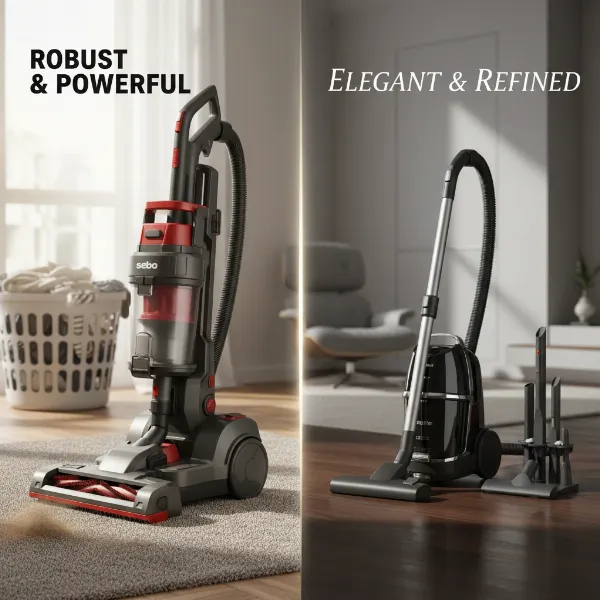 Visual comparison of Sebo and Miele vacuum cleaners, highlighting durability and luxury.
Performance and Durability
Both Sebo and Miele are celebrated for their powerful motors and effective cleaning capabilities. Sebo vacuums are known for their strong, consistent suction, with many users reporting that they rarely need to go over an area twice. Their automatic brush roll height adjustment system adapts seamlessly to different floor types, making transitions from hard floors to carpets effortless. Sebo models are often described as “tanks” due to their heavy-duty construction, with a focus on longevity, often boasting a lifespan of 20 years or more with minimal service.
Miele vacuums, particularly the Complete C3 models, feature powerful 1200-watt motors and variable suction control, providing excellent cleaning on various surfaces, including hardwood and low- to high-pile carpets. Miele’s build quality is also exceptional, utilizing high-end materials that contribute to a durable feel.
Filtration Systems
Filtration is a critical factor, especially for allergy sufferers. Sebo vacuums come standard with S-Class hospital-grade filtration, which is designed to absorb 99.9% of particles down to 0.3 microns. This advanced filtration not only ensures cleaner air but also protects the motor, contributing to the vacuum’s extended lifespan.
Miele offers interchangeable Active AirClean or HEPA filters, with their HEPA filters capturing 99.97% of particles. Some Miele models with HEPA H13/H14 filtration claim “literally ZERO PM2.5 particle ejection” at the exhaust, making them highly effective for severe allergy sufferers. While Sebo’s filtration is excellent, Miele’s highest-tier HEPA options might offer a slight edge for those with extreme sensitivities.
Ease of Use and Maneuverability
Miele canister vacuums, like the Complete C3, are praised for being “noticeably easier to maneuver in tight spots” due to their smaller, lighter bodies and smoothly rolling caster wheels. They also often feature convenient additions like six suction control settings with helpful pictographs for different surfaces and onboard storage for attachments.
Sebo vacuums, while powerful, are sometimes described as “big and traditional,” “clunky and basic,” or “heavy,” which can make them less agile than some Miele models. However, features like a long hose on some canister models (e.g., D1 series) prevent tipping, and their ability to lower flat to the ground makes cleaning under furniture feasible.
Cost of Ownership
The initial purchase price of both Sebo and Miele vacuums is substantial, but the long-term cost of ownership can differ. Sebo tends to offer “more accessible and affordable parts” such as filters and dustbags. Their larger dustbags also mean less frequent replacements, contributing to lower ongoing costs.
Miele’s replacement filters and bags are generally more expensive, and their dustbags tend to be smaller, requiring more frequent purchases. This means that while Miele offers premium performance, the cumulative cost of consumables can be higher over the vacuum’s lifetime.
Comparison Table: Sebo vs. Miele Key Aspects
| Feature | Sebo | Miele |
|---|---|---|
| Primary Focus | Durability, Robustness, Strong Suction | Premium Clean, Filtration, Quiet Operation |
| Build Quality | High-grade ABS plastic, “Tanks” built to last | High-end materials, feels very durable |
| Filtration | S-Class Hospital Grade (99.9% @ 0.3 microns) | Interchangeable Active AirClean/HEPA (99.97% @ 0.3 microns, some models near zero PM2.5) |
| Cleaning Power | Excellent, strong consistent suction | Powerful (e.g., 1200W motor), variable suction |
| Maneuverability | Can be bulky, but auto-adjusting heads help | Often more agile (canisters), smoother wheels |
| Noise Level | Moderately quiet for uprights | Generally known for quiet operation |
| Cost of Ownership | Lower (affordable, larger bags/filters) | Higher (more expensive, smaller bags/filters) |
| Typical Lifespan | 20+ years reported | Excellent, often 10-20 years with care |
| Suction Control | Less comprehensive | Six-speed suction control on many models |
| Common Types | Upright (X series), Canister (D series, E series) | Canister (C series), Upright, Cordless |
Essential Criteria for Choosing a Vacuum Cleaner
Selecting the perfect vacuum for your home involves more than just picking a brand. You need to consider several key factors to ensure it meets your specific cleaning demands.