Do you ever find yourself sneezing indoors, even after you’ve just cleaned? The invisible particles floating in your home’s air might be the culprit, silently impacting your health and comfort. If you’re wondering how to effectively tackle these microscopic invaders, you’ve likely encountered the term “HEPA filter.” But what exactly are HEPA filters, how do they work, and are they truly essential for your home? This comprehensive guide will demystify HEPA filtration, helping you understand its benefits and determine if it’s the right solution for your pursuit of a healthier living environment.
An Overview of HEPA Filters
HEPA stands for High-Efficiency Particulate Air, a designation that signifies a specific standard of air filtration. Officially defined by the U.S. Department of Energy, a true HEPA filter is a pleated mechanical air filter capable of capturing at least 99.97% of airborne particles that are 0.3 microns (µm) in diameter or larger. This 0.3-micron size is critical because it represents the “Most Penetrating Particle Size” (MPPS), meaning particles both larger and smaller than this benchmark are trapped with even higher efficiency.
The history of HEPA filtration dates back to the 1940s, when it was developed as part of the Manhattan Project to prevent the spread of radioactive contaminants. Since then, its remarkable efficiency has made it a cornerstone in various applications, from cleanrooms and medical facilities to common household appliances like vacuum cleaners and air purifiers.
HEPA filters function through a clever combination of physical mechanisms, trapping particles as air is forced through a dense mat of randomly arranged fibers, typically made from fiberglass or polypropylene. These fibers, usually between 0.5 and 2.0 micrometers in diameter, create a complex maze that captures particles in three primary ways:
- Impaction: Larger, heavier particles traveling in the airstream are unable to change direction quickly enough to navigate around the fibers and collide directly with them, becoming embedded.
- Interception: Particles, following the path of the air, come within one radius of a fiber and adhere to its surface.
- Diffusion: The smallest, ultrafine particles (less than 0.1 microns) move erratically due to collisions with gas molecules. This Brownian motion increases their likelihood of colliding with and sticking to the filter fibers.
This intricate design ensures that a wide spectrum of airborne contaminants is effectively removed, making the air you breathe significantly cleaner.
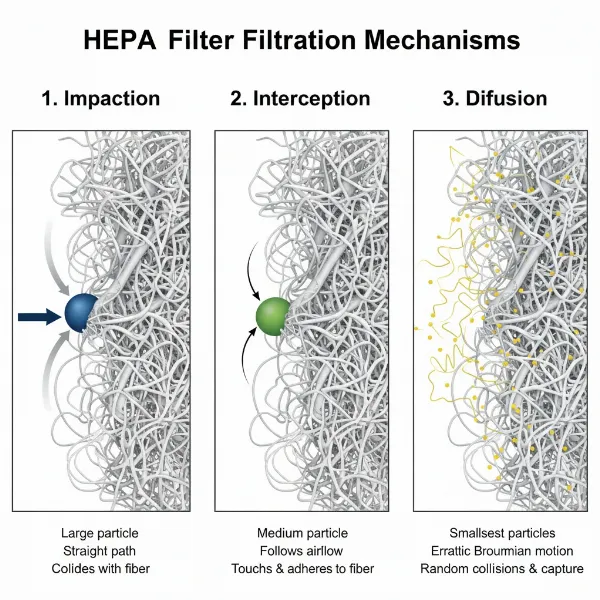 Diagram showing how HEPA filter fibers capture particles via impaction, interception, and diffusion.
True HEPA vs. “HEPA-Type”: What’s the Difference?
When shopping for air purification devices, you’ll often encounter various labels related to HEPA, and understanding these distinctions is crucial to ensure you’re getting the performance you expect. Not all filters marketed with “HEPA” in their name are created equal.
True HEPA Filters
|
Our Picks for the Best Vacuum cleaner in 2026
As an Amazon Associate I earn from qualifying purchases.
|
||
| Num | Product | Action |
|---|---|---|
| 1 | Bissell CleanView Compact Turbo Upright Vacuum with Quick Release Wand, Full Size Power, Compact Size for Apartments & Dorms, 3437F |

|
| 2 | Eureka PowerSpeed NEU181A Upright Vacuum Cleaner For Daily Cleaning for Pet-Owning Households , 5-Height Adjustment-Powerful Suction-Large Dust Cup-Pet Turbo Brush,Suitabe For Carpets & Hard Floors |
|
| 3 | Shark NV352 Navigator Lift Away Upright Vacuum, Hepa Filter, Anti-Allergen Technology, Swivel Steering, Ideal for Carpet, Stairs, & Bare Floors, with Wide Upholstery & Crevice Tools, Lavender |
|
| 4 | Cordless Vacuum Cleaner, 550W 45kPa 65Mins Vacuum Cleaners for Home with LED Display, Self-Standing Stick Vacuum with Anti-Tangle Brush, Rechargeable Vacuum Cordless for Pet Hair/Carpet/Floor |
|
| 5 | MONSGA Cordless Vacuum Cleaner, 45KPa 400W Stick Vacuum for Home, 50Mins Anti-Tangled Vacuum Cleaner with Charging Dock, Light-weighted Handheld Vacuum for Pet Hair/Carpet/Floor, LED Touch Display,MV3 |
|
| 6 | Bissell CleanView Compact Upright Vacuum, Fits in Dorm Rooms & Apartments, Lightweight with Powerful Suction and Removable Extension Wand, 3508 |
|
| 7 | Shark Upright Vacuum, Navigator Lift-Away Deluxe with Large Dust Cup Capacity, HEPA Filter, Swivel Steering, Upholstery Tool & Crevice Tool, Blue, NV360 |
|
| 8 | Eureka NEU10AE5 Powerful Bagless Upright Vacuum Cleaner Carpet and Floor, AirSpeed Ultra-Lightweight Vacuum Cleaner, w/ Replacement Filter, Blue |
|
| 9 | Eureka Lightweight Powerful Upright Vacuum Cleaner for Carpet and Hard Floor, PowerSpeed, New Model,Blue,black/New Model |
|
| 10 | UNINELL HOME Cordless Vacuum Cleaner, 45,000Pa/450W Stick Vacuum Cleaners for Home, 60 Mins Runtime, Self-Standing, Detachable Battery, Anti-Tangle Brush, Lightweight Wireless Vacuum for Pet Hair |
|
A “True HEPA” or “Absolute HEPA” filter adheres to the rigorous standards set by the U.S. Department of Energy. This means it has been independently tested and certified to capture 99.97% of airborne particles down to 0.3 microns. Filters with this designation provide a verified level of performance, making them a reliable choice for effective air purification. When a product claims “True HEPA,” it indicates a commitment to a high standard of filtration efficiency.
HEPA-Type or HEPA-Like Filters
Be wary of terms like “HEPA-type,” “HEPA-like,” or “99% HEPA.” These filters do not meet the stringent 99.97% efficiency standard for 0.3-micron particles. While they may offer some level of filtration, their performance can be inconsistent and significantly lower than that of a True HEPA filter. Manufacturers use these labels to suggest HEPA-level performance without having to meet the official certification requirements, potentially misleading consumers who are seeking genuine high-efficiency filtration. These filters often capture larger particles effectively but fall short on the microscopic allergens that often trigger sensitivities.
Beyond True HEPA: Medical-Grade Filtration
For those requiring even higher levels of air purity, there are filters that exceed True HEPA standards. Sometimes referred to as “Medical-Grade HEPA” or classified as H13 and H14 under European standards, these filters can capture up to 99.995% or even 99.999% of particles down to 0.1 microns. While often found in hospitals, laboratories, and specialized cleanrooms, some high-end consumer air purifiers also incorporate these advanced filters, offering an exceptional degree of air purification for highly sensitive individuals.
The Benefits of HEPA Filtration for Your Home
The presence of a True HEPA filter in your home appliances offers a multitude of benefits, primarily centered around significantly improving your indoor air quality and, consequently, your health and well-being.
One of the most profound advantages is the reduction of airborne allergens. HEPA filters are exceptionally effective at trapping common triggers such as:
- Pollen: Especially during allergy season, pollen grains can easily enter your home and become airborne.
- Dust Mites and Their Debris: These microscopic creatures thrive in household dust, and their waste products are potent allergens.
- Pet Dander: Tiny flakes of skin shed by animals are a major allergen for many.
- Mold Spores: These can circulate in the air and trigger respiratory issues.
- Bacteria and Some Viruses: While viruses are typically smaller than 0.3 microns, HEPA filters can still trap a significant portion by capturing the larger particles they often attach to.
For allergy and asthma sufferers, HEPA filtration is often recommended by medical professionals as a critical component of an allergy management strategy. By removing a vast majority of these irritants from the air, HEPA filters can help alleviate symptoms like sneezing, coughing, watery eyes, and shortness of breath, making your home a more comfortable sanctuary.
Beyond specific allergens, HEPA filters contribute to a generally healthier indoor environment by removing other microscopic pollutants, including fine dust, smoke particles (from cooking, candles, or wildfires), and other particulate matter that can irritate the respiratory system or contribute to long-term health issues. In an era where indoor air can often be more polluted than outdoor air, a HEPA filter acts as a vigilant guardian, constantly working to maintain a cleaner, fresher atmosphere within your living spaces.
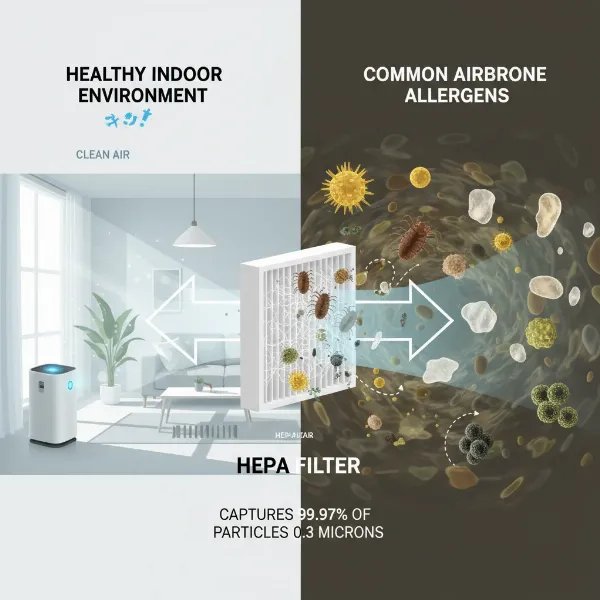 Healthy indoor environment with clear air, contrasting with common airborne allergens like pollen, dust, and pet dander.
Where You’ll Find HEPA Filters
HEPA filters are versatile and integrated into various appliances designed to improve air quality, with vacuum cleaners and air purifiers being the most common applications in residential settings.
HEPA in Vacuum Cleaners
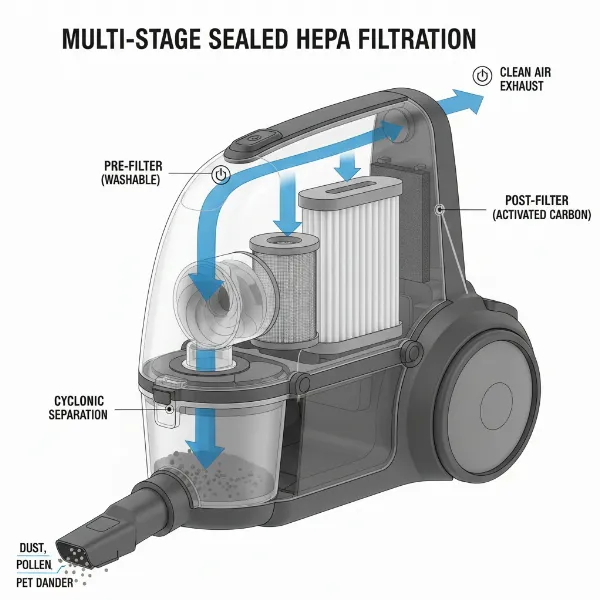
For allergy and asthma sufferers, a vacuum cleaner equipped with a True HEPA filter is indispensable. Traditional vacuum cleaners, lacking advanced filtration, can often suck up dust and allergens only to blow a significant portion of the fine particles back into the air through their exhaust. This recirculates allergens, potentially worsening symptoms and making cleaning counterproductive.
A HEPA vacuum cleaner, however, traps these microscopic particles within the filter, preventing them from escaping back into your home. It’s not enough for a vacuum to simply have a HEPA filter; a sealed system is equally important. A sealed HEPA vacuum ensures that all the air drawn into the machine passes through the HEPA filter before being exhausted, with no leaks around the filter or seams of the vacuum body. Without a sealed system, air (and the allergens it carries) can bypass the filter entirely, diminishing its effectiveness. Therefore, when selecting a vacuum for allergen control, prioritize models explicitly stating both “True HEPA filtration” and a “sealed system.”
HEPA in Air Purifiers
Dedicated air purifiers are designed to continuously filter the air in a specific room or area. Most high-quality air purifiers rely on True HEPA filters as their primary filtration stage, often combined with an activated carbon filter to tackle odors and gases. Unlike vacuum cleaners which operate intermittently for cleaning surfaces, air purifiers work passively to maintain consistent air quality, making them ideal for bedrooms, living rooms, or home offices where you spend a lot of time. They are particularly beneficial for capturing airborne particles that settle slowly or remain suspended, offering a continuous defense against allergens and pollutants.
HEPA in HVAC Systems
While less common in standard residential HVAC systems, HEPA filters are sometimes integrated into whole-home filtration solutions. However, true HEPA filters are very dense and can restrict airflow significantly, which may not be compatible with standard residential HVAC blowers without modifications. More commonly, residential HVAC systems use filters with a Minimum Efficiency Reporting Value (MERV) rating. While a higher MERV rating indicates better filtration, even the highest residential MERV filters typically don’t match the efficiency of a True HEPA filter (which is equivalent to MERV 17 or higher). For whole-house HEPA filtration, specialized systems are usually required.
Choosing a HEPA-Equipped Vacuum Cleaner: A Buying Guide
Investing in a vacuum cleaner with a HEPA filter can significantly improve your indoor air quality, especially if you or a family member suffers from allergies or asthma. However, navigating the market requires careful consideration.
Look for “True HEPA” Certification
This is perhaps the most crucial criterion. As discussed, a “True HEPA” filter guarantees 99.97% particle capture at 0.3 microns. Avoid ambiguous terms like “HEPA-type” or “HEPA-like” if comprehensive allergen removal is your priority. Always verify the manufacturer’s claims and look for clear certification.
Consider a Sealed System
A HEPA filter’s effectiveness is severely compromised if the vacuum cleaner isn’t properly sealed. A sealed system ensures that all the air picked up by the vacuum passes through the filter before being expelled. If air leaks out through cracks or unsealed compartments, allergens can escape back into your environment. High-quality HEPA vacuums are designed with airtight seals to prevent this bypass filtration.
Assess Your Needs
Think about your home environment and cleaning habits:
- Floor Types: Do you have mostly carpets, hard floors, or a mix? Different vacuums excel on different surfaces. Look for adjustable settings or specialized attachments.
- Pet Ownership: Pet dander is a common allergen. Vacuums designed for pet hair often come with strong suction and specialized tools in addition to HEPA filtration.
- Home Size and Layout: For larger homes, a canister or upright vacuum might be more suitable, while smaller spaces or quick clean-ups might benefit from a cordless stick or handheld model with HEPA.
- Allergen Severity: If allergies are severe, prioritize the highest filtration efficiency and a fully sealed system.
Maintenance and Filter Replacement
HEPA filters are not eternal. They require either cleaning (if washable, though this can sometimes reduce efficiency over time) or replacement to maintain their performance. Understand the recommended replacement schedule and the cost of replacement filters for any model you consider. Skipping filter maintenance can lead to reduced suction and ineffective filtration, eventually re-releasing trapped particles.
Brand Reputation
While features are important, the reputation of the brand can indicate reliability and quality of filtration. Brands frequently praised for their allergy-friendly vacuum cleaners include Miele, Dyson, and Shark. These manufacturers often invest in robust filtration systems and sealed designs. Reading reviews and consumer reports can provide valuable insights into real-world performance.
Maintenance and Longevity of HEPA Filters
To ensure your HEPA filter continues to deliver optimal air purification, proper maintenance is essential. Neglecting your filter can lead to decreased efficiency, reduced airflow, and potentially even the re-release of trapped particles into your home.
The maintenance requirements for HEPA filters vary depending on whether they are washable or non-washable.
- Non-Washable HEPA Filters: Most True HEPA filters are not designed to be washed. Attempting to wash them can damage the delicate fibrous structure, compromising their ability to capture microscopic particles and rendering them ineffective. These filters typically require replacement at regular intervals, usually every 6 to 12 months, depending on usage and the manufacturer’s recommendations. Regular vacuuming in a dusty environment or with pets may necessitate more frequent replacement. It’s crucial to adhere to the manufacturer’s guidelines to ensure continuous high performance.
- Washable HEPA Filters: Some HEPA filters are explicitly labeled as washable. If you have one, follow the manufacturer’s instructions carefully for cleaning. This usually involves rinsing under cool water until the water runs clear and allowing the filter to air dry completely (for at least 24 hours, or as specified) before reinserting it into the appliance. Installing a damp filter can lead to mold growth and damage to the device. While washable filters can save on replacement costs, their long-term efficiency might slightly diminish over multiple washes compared to consistently replacing non-washable filters.
The impact of a clogged filter on performance is significant. As a HEPA filter traps more particles, its pores become increasingly blocked. This buildup reduces airflow, forcing your vacuum or air purifier to work harder, which can decrease suction power or air delivery rate, and potentially shorten the lifespan of the motor. A heavily clogged filter also becomes less effective at trapping new particles, eventually allowing them to pass through or escape from the appliance.
“The right filter, properly maintained, is a silent guardian against unseen pollutants, tirelessly working to create a healthier sanctuary within your home.”
Consider the cost of replacement filters when purchasing an appliance. While the initial investment in a HEPA-equipped device might be higher, ongoing filter costs are part of the equation for sustained clean air. Many brands offer multi-packs or subscription services for filters, which can sometimes provide savings.
Conclusion
HEPA filters represent a gold standard in air purification, offering a proven solution for significantly improving indoor air quality. Their ability to capture 99.97% of particles as small as 0.3 microns, including common allergens like pollen, dust mites, pet dander, and mold spores, makes them an invaluable asset for anyone seeking a healthier home environment. For allergy and asthma sufferers, particularly, choosing appliances with a “True HEPA” filter and a sealed system is not just a convenience, but often a necessity for mitigating symptoms.
So, do you really need a HEPA filter? If you value cleaner air, suffer from allergies or asthma, have pets, or simply want to reduce your exposure to airborne pollutants, the answer is a resounding yes. It’s an investment in your health and comfort, transforming your home into a cleaner, more breathable space.
What steps will you take today to upgrade your home’s air quality with HEPA filtration?
Frequently Asked Questions
What exactly is a micron, and why is 0.3 microns important for HEPA filters?
A micron, or micrometer, is a unit of length equal to one-millionth of a meter. To put it in perspective, a human hair is typically 50 to 100 microns thick. The 0.3-micron standard for HEPA filters is crucial because it represents the “Most Penetrating Particle Size” (MPPS), meaning particles of this size are the most difficult to trap, making it a rigorous benchmark for filtration efficiency.
How often should I replace or clean a HEPA filter?
The frequency depends on the filter type (washable vs. non-washable), usage, and household conditions (e.g., pets, high dust levels, allergy sufferers). Generally, non-washable HEPA filters in vacuum cleaners or air purifiers should be replaced every 6 to 12 months. Washable filters require cleaning as per manufacturer instructions, usually when visibly dirty or when performance drops, ensuring they are fully dry before reinstallation.
Can HEPA filters capture viruses like those causing the common cold or flu?
Yes, True HEPA filters can capture a significant percentage of viruses, including those like influenza and coronaviruses. While many individual virus particles are smaller than 0.3 microns, they often travel in aerosols or attach to larger droplets and particles (like dust), which HEPA filters effectively trap.
Is a HEPA filter vacuum cleaner genuinely better than a regular vacuum for allergies?
Absolutely. Regular vacuum cleaners often re-circulate fine dust and allergens back into the air through their exhaust, potentially worsening allergy symptoms. A True HEPA vacuum cleaner, especially one with a sealed system, is designed to trap these microscopic particles within the machine, significantly improving indoor air quality and providing substantial relief for allergy sufferers.
Are all HEPA filters the same, or are there different grades?
No, not all filters labeled “HEPA” are the same. “True HEPA” filters meet a specific standard (99.97% of particles 0.3 microns and larger). “HEPA-type” or “HEPA-like” filters do not meet this standard and are less efficient. There are also higher grades, such as Medical-Grade HEPA (H13 or H14), which offer even greater efficiency, capturing more than 99.99% of very fine particles.